
2 Jul 2026
,France
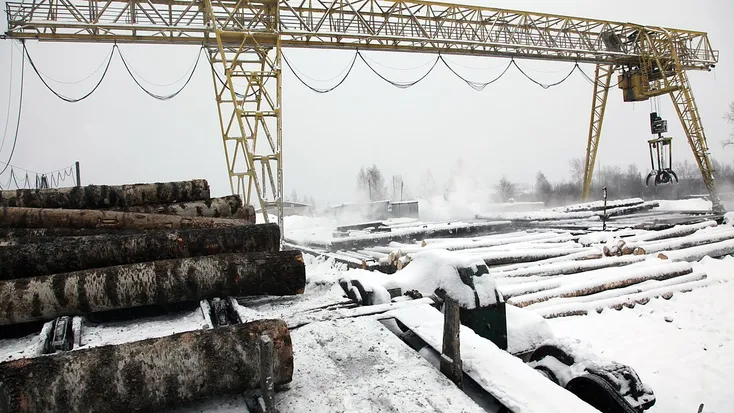
Russia's forestry sector has swung from a net profit of 24.3 billion roubles in 2021 to a net loss of 11.1 billion roubles in 2024, as sanctions, collapsing export markets, and costly borrowing push the industry toward systemic crisis. A study by the Siberian Branch of the Russian Academy of Sciences found that corporate debt in the sector rose 1.6-fold over the same three-year period, with researchers warning that the deterioration may soon become irreversible.
Approximately half of all forestry companies recorded losses last year. Falling revenues have depleted financial reserves while elevated interest rates have made external financing increasingly inaccessible. Smaller producers face the sharpest pressures, possessing the thinnest capital buffers and the least capacity to absorb rising costs as orders dry up.
The breadth of the losses makes consolidation an unlikely remedy. With losses spread across so many balance sheets simultaneously, healthier companies lack the means to absorb failing ones. Researchers instead anticipate a wave of insolvencies.
"Dozens of companies are set to go through bankruptcy," the study's authors warn.
The financial damage is directly tied to the collapse of markets that Russia turned to after losing access to Europe. Following the European Union's ban on Russian timber imports in 2022, producers redirected nearly all of their output to Asia — a pivot that initially absorbed some of the shock but has since become a source of acute vulnerability.
Russian sawn-timber shipments to China fell 30% year on year to 2.6 million cubic metres in the first four months of 2026, while export revenue from that trade dropped 26% to $603.7 million over the same period. The declines are not confined to China: shipments to Japan fell 19% and to South Korea 18% during the same stretch. In total, Russian sawn-timber exports dropped 32% to roughly 4 million cubic metres in the first four months of the year.
The scale of Russia's exposure to a single weakening market is striking. China absorbed 11.2 million cubic metres of Russian sawn timber in 2025 — approximately half of Russia's total exports — creating a structural dependence that is now working against the industry. China's prolonged property downturn has substantially eroded construction demand, with home sales by value falling 9.5% in 2025 to their lowest level since 2009, directly suppressing appetite for imported timber.
The situation is compounded by currency dynamics. A stronger rouble has eroded Russian timber's price competitiveness across Asian markets at precisely the moment when demand is already contracting. Higher freight costs add further pressure on margins that are, for many producers, already negative.
Consultancy Strategy Partners projects that Russian timber exports will fall a further 7–10% in 2026, citing weak construction demand, elevated logistics costs, and currency headwinds. With no near-term prospect of re-entering European markets and Asian demand showing few signs of recovery, researchers see a return to profitability as more than a year away — and, for a significant portion of the sector, potentially out of reach entirely.