yesterday at 11:29
,Romania
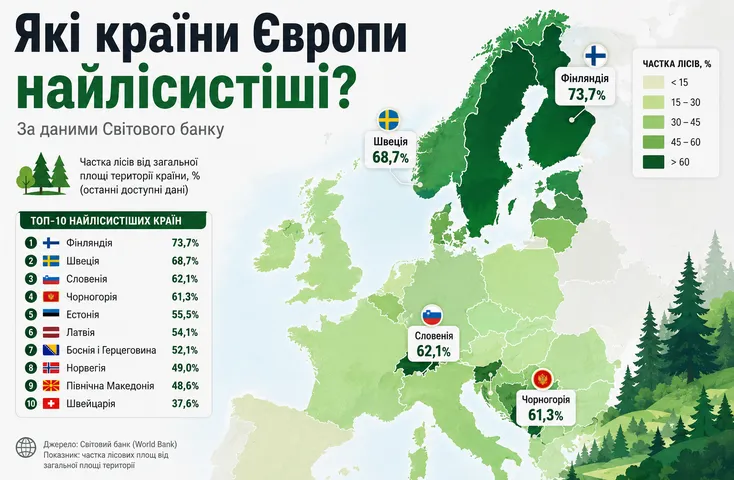
Infographic compiled on the basis of World Bank data clearly demonstrates how unevenly forests are distributed across the territories of European states. The gap between the most and least forested countries of the continent is enormous — behind it lies a complex interplay of geography, climate, and centuries-old history of land development.
Finland and Sweden remain the undisputed leaders of the ranking: forests cover about seventy percent of their territory. The top group also includes Montenegro and Slovenia — countries where natural conditions favored the preservation of vast forest areas. At the opposite end of the scale are countries with a high share of urbanized or agricultural land, where forest cover is significantly more modest.
European forests are extremely diverse. In the north of the continent stretch boreal forests — taiga, covering Finland, Sweden and Russia. Further south they give way to mixed and broadleaf forests with a different species composition and ecological characteristics.
The high level of forest cover in Northern Europe is largely determined by the boreal belt: the harsh climate and low population density have historically constrained agricultural development, allowing large forest ecosystems to exist almost untouched. A different picture is observed in Denmark and the Netherlands: the fertile plains of these countries have been actively plowed and settled over the centuries, inevitably leading to a reduction in forest land.
Mountainous terrain acts in the opposite direction. Steep slopes are poorly suited to intensive agricultural development, so in Slovenia, Austria and a number of Balkan states forests have been preserved thanks to the inaccessible mountain landscape. Thus, elevation above sea level and the nature of the terrain often prove to be decisive factors determining the state of forest cover.
Natural conditions are far from the only variable in this equation. State policy in the field of forest management, nature conservation programs and targeted reforestation have allowed a number of countries not only to preserve but also to increase their forest area. In some regions forests are expanding naturally: abandoned low-productivity agricultural lands are gradually becoming overgrown. This explains why two countries with similar climates can show fundamentally different forest cover indicators — everything depends on the history of land use and current management decisions.
Against the backdrop of global forest cover decline, Europe stands out as an exception: over the past thirty years the area of forests on the continent as a whole has been growing. This growth continues even despite more frequent forest fires, droughts, windthrows and outbreaks of pest insects. The report State of Europe's Forests 2025 confirms the positive trend, yet also records increasing pressure on forest ecosystems.
Forest cover and biodiversity indicators are improving overall, although in some regions growth rates are slowing and threats from logging, natural disturbances and climate change are intensifying.
— State of Europe's Forests 2025
An increase in forest area does not in itself mean the problem is solved. The task of preserving healthy, resilient and self-recovering forest ecosystems is becoming increasingly complex and requires an integrated approach — one in which economic interests, the climate agenda and nature conservation objectives are considered inseparably.