9 Jul 2026
,Finland
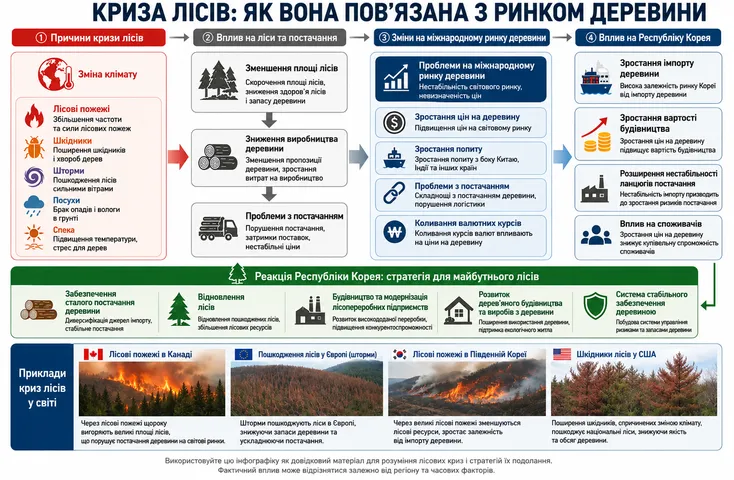
The forces driving the international timber market are changing. In the past, demand-side variables such as construction market conditions or manufacturing demand dominated price trends, but now supply-side risks are emerging as the key variable in the market. Climate change, pest spread, large-scale wildfires, typhoons, war, and logistics disruptions are acting in combination, shaking the stability of the timber supply chain itself.
Timber is a resource-based industry where increasing production volume in the short term is difficult. Trees take decades to grow, and if forests are damaged, recovery also requires a correspondingly long time. Repeated global forest damage is now going beyond a simple environmental issue and changing the very structure of the international timber market.
The impacts of climate change are appearing in multiple ways. Droughts and heatwaves slow tree growth and increase the risks of pests and wildfires. Typhoons and heavy rainfall make logging and transportation difficult, causing supply disruptions. In particular, pest damage spreading in North America and Europe, combined with climate change, is cited as one of the biggest future timber supply risks. While fire-damaged timber may be released into the market in the short term, it ultimately reduces the area of productive forest, weakening supply stability over the long term.
A more fundamental change in the international timber market is not simply rising prices but declining market predictability. In the past, market forecasts could be made to some extent through construction cycles and demand indicators. However, variables such as abnormal weather, war, and logistics disruptions are shaking supply chains in unpredictable ways, exposing the limitations of existing analytical frameworks.
Transportation costs cannot be overlooked either. Timber is a product with a high proportion of transportation costs relative to its volume, so fluctuations in international oil prices and shipping rates are directly reflected in the prices of logs and wood products. When port congestion or disruptions in maritime routes occur, the impact is amplified. Ultimately, the global timber market is shifting toward one where supply stability is more important than price competition, and international timber prices are now determined by a complex interplay of forest health, supply chain stability, logistics, and energy costs in addition to supply and demand.
Korea is not free from this trend either. Repeated large-scale wildfires in regions such as Uljin and Samcheok in North Gyeongsang Province, along with the ongoing spread of pine wilt disease, demonstrate that the global forest crisis is no longer just an overseas issue. At the same time, Korea relies on imports for most of its timber consumption, making it inevitably vulnerable to rising international timber prices, exchange rate fluctuations, and increased shipping costs.
In this situation, expanding the use of domestically produced timber goes beyond simple industrial development. Efficient utilization of timber damaged by wildfires and pests, expansion of drying and processing facilities, and strengthening the production base for long-life wood products can serve as practical means to enhance supply stability. Diversifying import sources and reinforcing domestic production capacity are key response strategies to mitigate shocks from international supply chains.
Just as food security and energy security have become central agendas in national strategy, timber must now be treated as a critical resource whose stable supply base should be managed at the national level. The question of how to conserve and utilize forest resources is becoming a strategic choice directly linked to the future of Korea’s industrial competitiveness, extending beyond the realm of environmental policy.