
5 Jul 2026
,Australia
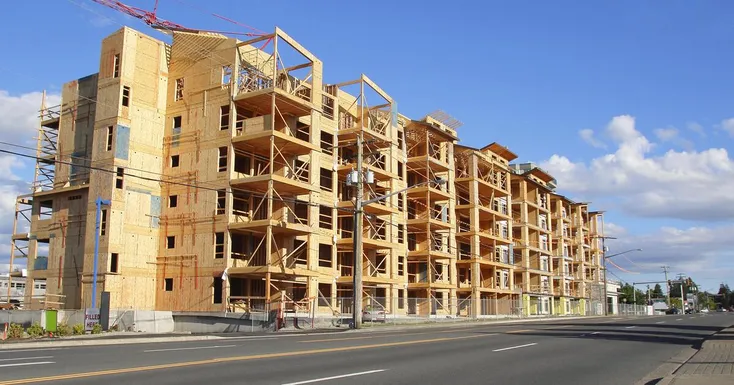
Germany currently lacks around 1.4 million apartments, according to recent studies. At the same time, rising construction costs, expensive materials, and a persistent shortage of skilled workers are making new projects considerably more difficult. In this situation, an old building material is once again moving to the center of the debate: wood.
The planned Berlin wooden high-rise WoHo was intended to become a flagship project — featuring subsidized apartments, a public swimming pool, and a rooftop café. Instead, the project failed: the planning authorities rejected it, arguing that it did not fit the cityscape. A symbolically charged setback for a construction method that many see as an answer to the housing crisis.
Yet the legal framework for timber construction has improved significantly in recent years. Building with wood is now permitted up to the height limit for high-rises — a regulatory advance that would have been unthinkable just a few years ago. Particular attention is being given to serial and modular construction methods, which recall the prefabricated panel buildings of past decades, but this time with an ecological focus.
Chancellor Friedrich Merz has clearly come out in favor of this approach.
„Serial construction with wood benefits the climate and quickly creates new housing."
– Chancellor Friedrich Merz
Timber construction is indeed growing in Germany — especially in single- and two-family homes. In multi-family housing, however, concrete and sand-lime brick still dominate. This has historical reasons: experiences with fires after the Second World War created a strong tradition of solid construction that continues to influence building practices today.
However, experts consider the widespread concern that wooden buildings are particularly fire-prone to be unfounded. Countries with a high proportion of timber buildings do not show any notable fire statistics. Moreover, burning wood behaves predictably in a fire: it chars on the surface and loses its load-bearing capacity more slowly than some types of steel.
Wood scores ecologically in any case: it is a renewable resource, binds CO₂, and stores it for decades once used in construction. That does not automatically make it cheaper than conventional masonry construction. The real cost drivers in the building sector are individual planning, elaborate architecture, and complex building services. This is precisely why serial construction is regarded as a key lever: around 80 percent of all wooden buildings are already industrially prefabricated today. The material’s low weight, ease of processing, and simple assembly enable significant savings in construction time.
Wooden modules are particularly well suited for digitally planned buildings in which every detail is fixed in advance and only needs to be assembled on site. The performance of this method is demonstrated by the Luisenblock West of the German Bundestag: the seven-story office building was completed in just over twenty months — a pace rarely achievable with conventional construction.
Serial and modular building can also save skilled labor, a strong argument given the shortage of tradespeople. Nevertheless, public procurement rules continue to slow down many projects: contracts are often put out to tender in separate lots rather than as a single package, which can nullify the efficiency gains of modular approaches. Economically, the method pays off above all in large-scale projects — for example, in the development of entire new neighborhoods, such as those currently underway in Berlin-Tegel or in Mannheim’s Franklin district.
For investors, timber construction is becoming increasingly attractive due to its low CO₂ footprint. However, growing interest also raises questions: are Germany’s forests sufficient as a source of raw materials? Experts consider the use of domestic commercial forests acceptable for the next twenty years, while stressing the need for consistent forest conversion toward stable mixed woodlands.
Then there is the question of aesthetics. Serial timber buildings do not have to be monotonous — good architecture can make modular structures visually appealing as well. Wooden high-rises could therefore become an important addition in the fight against the housing shortage. However, they do not automatically guarantee affordable construction or convincing design. That remains a question of political will, planning — and craftsmanship standards.