
9 Jul 2026
,China
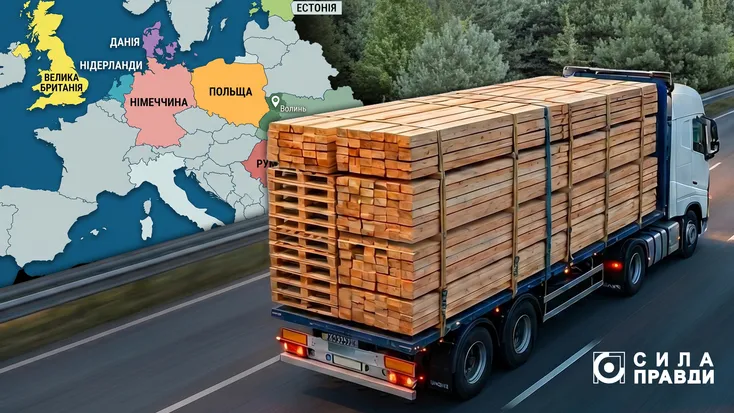
In 2024, 384.6 thousand cubic meters of timber products made from 693.8 thousand cubic meters of raw materials were exported from the Volyn region. In 2025, volumes decreased by almost 14% — to 339.2 thousand cubic meters of products from 638.2 thousand cubic meters of raw materials. This data is based on certificates of origin for wood, which record both the volume of raw materials used and the final products manufactured.
Volyn timber products were supplied to more than 20 countries — European states, as well as Hong Kong, Great Britain, and the USA. Pine remained the dominant species in export products in both years: its share exceeded 96%. Oak, hornbeam, and other species held significantly smaller positions.
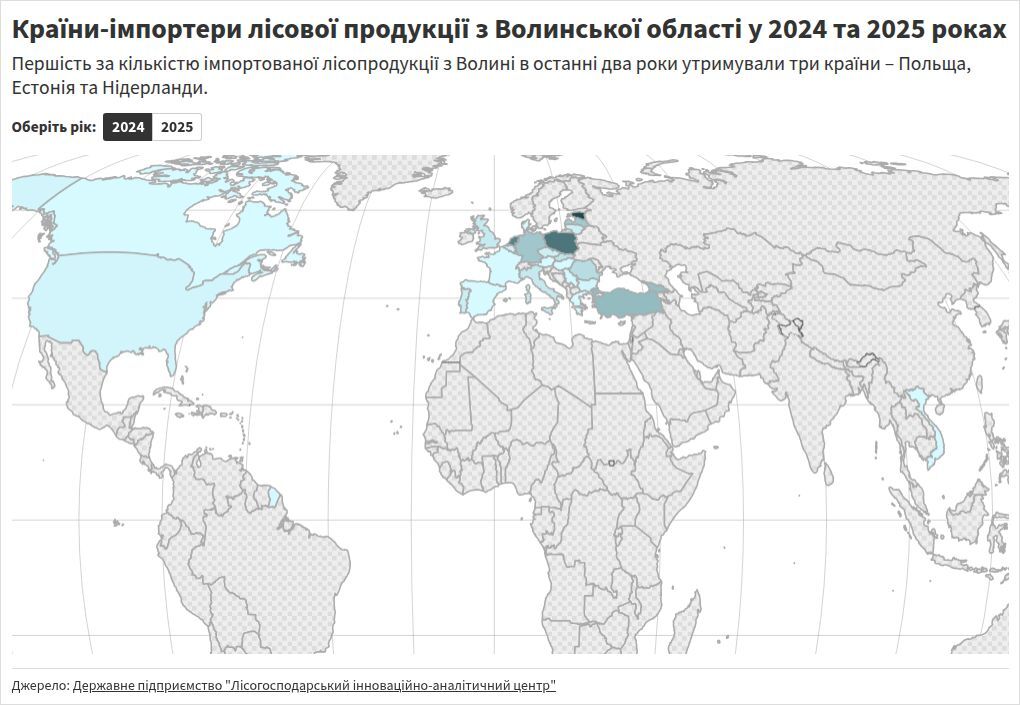
The structure of sales markets changed somewhat between 2024 and 2025. In 2024, Estonia was the largest importer with a 22.2% share, followed by Poland with 16.7% and the Netherlands with 15.2%. In 2025, leadership passed to Poland — 33.1%, followed by Estonia with 17.6% and the Netherlands with 15.4%. The smallest volumes among all importers went to Greece and Denmark — 0.01% each of exported products.
Both state and private enterprises operate in the timber export market — forestry enterprises of the State Enterprise “Forests of Ukraine” and wood-processing companies. The largest supplier of raw materials whose products were exported was the “Polissia Forest Office” branch of the State Enterprise “Forests of Ukraine”: in 2024–2025, it sold over 368 thousand cubic meters of timber through exchange auctions. Other notable forestry enterprises whose certificates were used for exports include the Liuboml, Kivertsi, and Volodymyr-Volynskyi forest enterprises.
Timber is sold through open auctions, where both Ukrainian entrepreneurs and foreign companies can purchase it. Due to the 2015 moratorium on the export of roundwood, only processed raw materials may be exported abroad: sawn timber, firewood, wood chips, shredded wood, etc. Sawn timber accounted for the largest share of exports — 289.9 thousand cubic meters, including boards, blanks for euro pallets, and parquet. Other notable categories included wood chips, fuel firewood, and stakes. In 2024, Volyn enterprises also supplied 12.8 thousand cubic meters of industrial firewood to Romania.
To arrange exports, a certificate of origin for timber is required, which can now be obtained online — through the “EcoSystem” platform or the “Diia” app. Despite this, attempts to illegally export timber using forged documents are recorded in Volyn.
In 2024, the “Polissia Forest Office” found itself at the center of a scandal: law enforcement officials raised suspicions regarding a scheme to understate the value of timber during export. Enterprise representatives denied the accusations.
“We do not export products ourselves but sell them at exchange auctions and provide services to non-residents,” the “Polissia Forest Office” stated.
Despite the scandal, the enterprise remains one of the leaders among forest users whose raw materials are used for the production of export products, including in 2026. At the same time, for 2026 the Cabinet of Ministers set zero quotas for the export of unprocessed and fuel wood, effectively banning its export to support domestic needs under wartime conditions.
The material was prepared by the Center for Journalistic Investigations “Syla Pravdy” as part of a project to strengthen public oversight in Ukraine.