

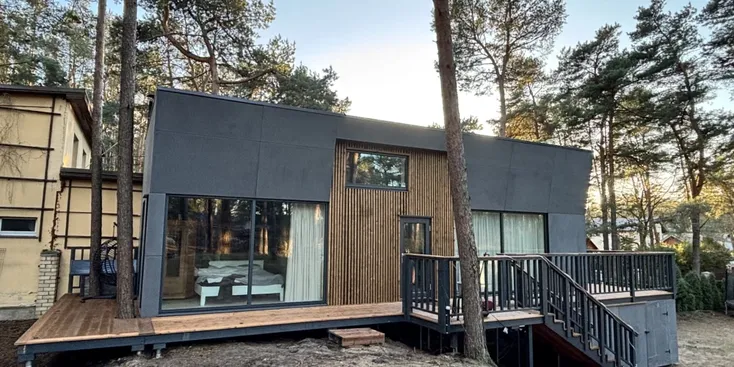
As part of a procurement by the Latvian Ministry of Economy, 12 modular homes manufactured in Latvia have been delivered to Ukraine to provide temporary shelter for residents whose homes were destroyed in Russian attacks. The project implementer CMB Housing Solutions notes that the technical solution has proven effective, although the project’s execution was nearly disrupted by logistical complications.
In total, 12 homes consisting of 24 modules were delivered to Ukraine. The goal of the project was to provide fully ready-to-live-in spaces in a short time for people who lost their homes due to the war.
According to the project implementers, feedback from Ukraine has been positive, and the modular homes “have withstood the test of time.” In the context of humanitarian aid, this is crucial — it’s not just about delivery, but also ensuring that the solution remains practically usable in the long term after installation.
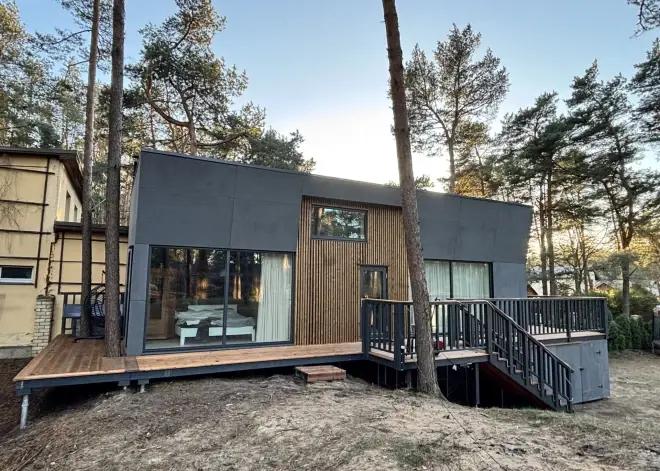
The biggest challenge in the project was the pace of execution: within four months, 12 homes, or 24 modules, had to be delivered to Ukraine. The company considers the production phase relatively predictable, but external factors during transportation caused significant delays.
The deliveries coincided with a period of road protests in Poland. As a result, trucks had to wait at the Polish border for up to three weeks. The situation was further complicated by contract terms that required the next units to be dispatched while the previous ones were still en route. With modular cargo getting stuck, “there was simply no way to transport them.” The project was completed thanks to a deadline extension of a few weeks.
An additional paradox arose from the humanitarian aid status: entering Ukraine was possible, but as those involved in the project noted, “getting out of there was not,” due to rapidly changing logistics flows and border crossing conditions.
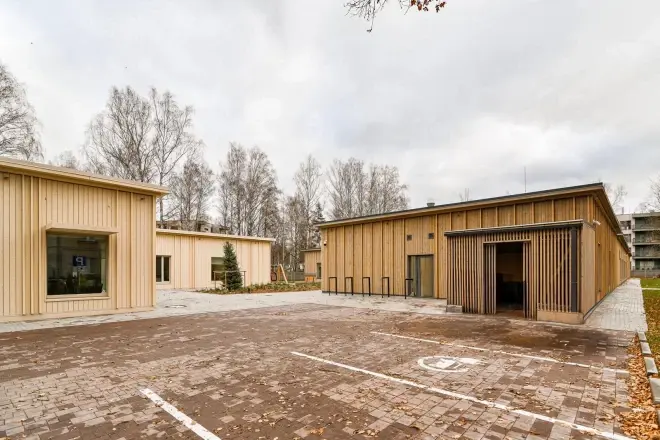
In modular construction, each module is a factory-prepared “wooden box” with an area of up to approximately 40 square meters. Unlike panel construction, where individual elements are assembled on-site, modules are fully completed at the factory and delivered ready to the installation site, significantly reducing assembly time.
“There’s no point in ordering a module so wide that it can’t be transported on public roads.”
Typical module dimensions are approximately 13.5 meters in length and about four meters in width and height. Modules can be connected and combined according to needs: a roughly 70-square-meter home requires two modules, while 105 square meters need three. They can also be connected with offsets, and technically, both horizontal and vertical construction is possible, allowing for multi-story buildings.
In Latvia, modular solutions have been used, for example, to create rest areas for drivers, and in Jelgava, a modular five-story rental building has been constructed. Abroad, projects with modular buildings up to 20 stories high have been implemented. Design options are varied — for instance, staircases can be placed outside, though internal staircases are also technically feasible.
The project in Ukraine highlights a key conclusion for both the industry and crisis procurement contexts: production and technological execution can be ensured relatively predictably, while logistics risks — border crossings, protests, and traffic restrictions — can become the decisive factor even if the product is ready on time. Positive feedback from Ukraine simultaneously confirms that the solution is viable, and in future similar projects, special attention will need to be paid to the resilience of the supply chain.