yesterday at 15:29
,Czech
For decades, sustainable construction has been presented as a forced choice: wood, concrete or steel, but not a combination of all three. An ambitious scientific project coordinated by the University of Granada has challenged that premise by demonstrating that different materials can work together within the same structural element, harnessing the optimal properties of each. The result is hybrid beams and slabs that are lighter, less polluting and already certified for commercial use.
The LIFE Madera para el Futuro project, funded by European grants and backed by a public-private partnership, brought together forty researchers over four years and mobilized an investment of more than nine million euros. Its promoters describe it as an initiative that has transformed a sector that had long been stagnant.
The project "has laid the foundations for a better future in a sector that was almost invisible and disillusioned."
The first product developed is the MCLam laminated beam, which integrates poplar and laricio pine in a single piece. The distribution is not arbitrary: laricio pine provides mechanical strength where it is most needed, while poplar acts as a lightweight filler, reducing the total weight of the element. The result is a beam that can be up to 20 % lighter than its equivalent made solely from pine, without sacrificing stiffness or load-bearing capacity.
Tests carried out at the PEMADE laboratory awarded these beams the GL24C and GL26C classifications, above the usual market standard. A prototype with 40 % laricio pine achieved almost 13,000 megapascals of modulus of elasticity, exceeding the research team’s initial expectations.

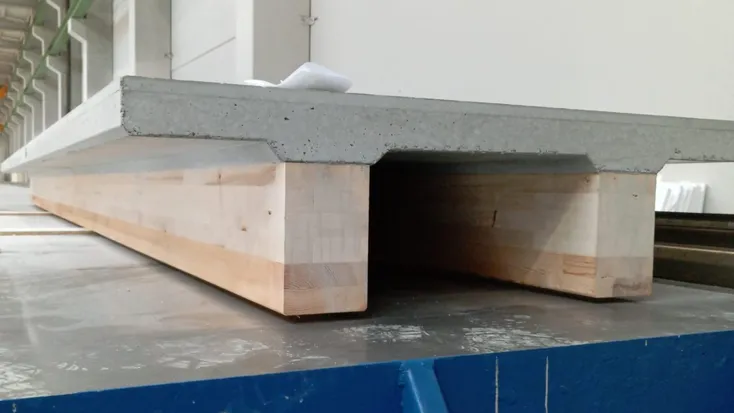
The second development, the MCLam BS composite slab, combines laminated wood and concrete, distributing functions according to the capabilities of each material: the wood absorbs tensile forces while the concrete takes the compression. This solution is especially designed for buildings with large spans, particularly openings over six meters, where other wood alternatives lose competitiveness against conventional floor systems. Compared with a standard concrete floor, the MCLam BS slab is 40 % lighter, reduces the carbon footprint by up to 70 % and the water footprint by 45 %.
The new products did not remain in the laboratory. The MCLam beams were used in the construction of a pilot house in Ogíjares, in the province of Granada, while the composite slab was employed in the renovation of a traditional manor house (pazo) in Galicia. Both products have received certification from the Instituto Tecnológico de la Construcción, enabling their use in real construction projects with full technical and legal guarantees.
One of the project’s most significant regulatory achievements is the inclusion, for the first time, of poplar wood in the Spanish and European structural standards. This recognition opens the door to a forest species that has historically been underused, whose industrial exploitation could reduce dependence on laminated timber imported from Central Europe and generate economic opportunities in rural areas.
The poplar from the Vega de Granada is the protagonist of this push for local sourcing. Its integration into local value chains could revitalize the forestry sector, the processing industry and employment in rural areas. To realize this potential, the project has promoted the creation of the spinoff Iberolam Timber&Technology, majority-owned by poplar and pine forest owners. The company plans to open a factory in Valderrubio in 2026, integrated into an industrial hub that includes training in Santa Fe and research and development in Granada.
The partial replacement of cement and steel with locally sourced timber not only reduces emissions associated with material production but also allows the carbon sequestration inherent in tree growth to be capitalized. The technology already has a solid technical and commercial foundation. The remaining challenge is to scale up from pilot buildings to wider adoption in the construction sector.