today at 15:29
,Czech
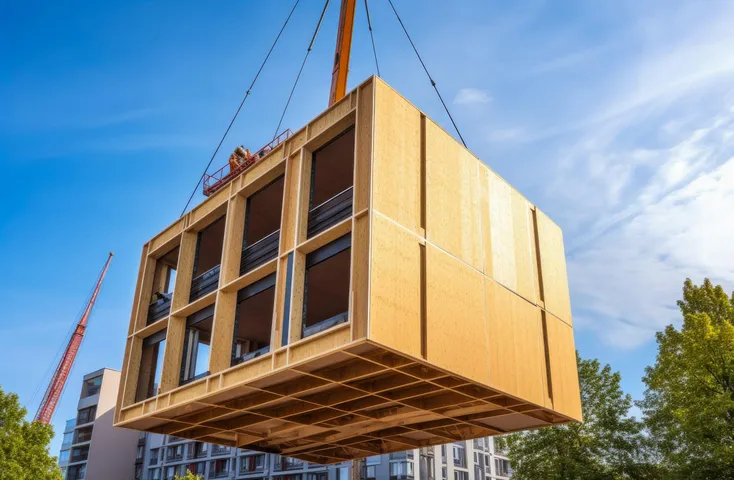
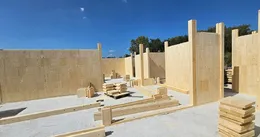
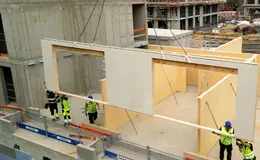
Timber frame and prefabricated construction has held a well-established position in Europe for years, effectively displacing traditional technologies in many segments. In Germany, Switzerland, Austria and the United Kingdom, modular structures have become the standard for hotels and dormitories, while in Scandinavia they dominate residential construction. Prefabricated bathrooms, lightweight extensions and modular building elements have become widespread thanks to shorter assembly times and reduced structural weight. It is worth remembering, however, that the very concept of “traditional technology” varies from country to country — in Poland it usually means heavy walls and floors, in Scandinavia timber framing, and in England also steel framing.
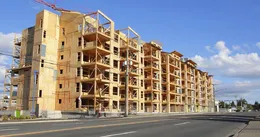
It is becoming increasingly clear that in contemporary construction, the designer’s competence matters more than the choice of material itself. The designer must match the system to the investor’s needs and the building’s function, deciding between modular and panel technology as well as between timber and steel framing. It is particularly important to note that design errors in prefabrication are far more difficult to rectify than in traditional construction. In Poland, more than half of prefabrication is based on lightweight timber framing: according to 2024 data, 2D panels accounted for 41.5% of the market and 3D modules for another 11.2%. Steel remains the material of choice for large hotels, dormitories and multi-family buildings, offering high strength and design flexibility. Timber frame technology is now entering increasingly tall and large-scale projects, which requires thinking not only about the material but about the entire structural system. This is confirmed by specific projects — the school in Pruszków, the housing estate in Zawada and the modular hospital in Ostróda — which prove that timber framing performs equally well in public buildings, residential developments and facilities with high functional requirements.
Growing acoustic, fire-resistance, functional and aesthetic requirements necessitate the use of modern systems dedicated to timber frame construction. The designer must understand the properties of the entire partition — its fire resistance at REI 60, REI 90 or higher, sound insulation expressed by the Rw index, and long-term vapour diffusion. Acoustics remains one of the main challenges of this technology.
“Significantly weaker acoustics than in traditional construction” — this reservation is something designers and system suppliers must address today at the level of the entire partition, not a single product.
The market response is a shift by manufacturers from selling individual products to offering complete systems that reduce the risk of errors and facilitate repeatable design. An example of this approach is Siniat, which communicates its solutions through specific technical parameters: structural performance, fire resistance and acoustics. The Defentex board serves as an alternative to OSB, combining comparable mechanical strength with a better fire reaction class — A2-s1, d0 compared with D-s2, d0 for OSB. Gypsum boards, in turn, improve the vapour permeability of the wall and reduce the risk of condensation in multi-layer partitions.
In response to the requirements of hotels, hospitals and premium apartments, products that combine several functions at once are being developed. Nida Cicha provides declared sound insulation of 69 dB and can achieve Rw = 70 dB with fire resistance (R)EI 120. Nida Twarda — an alternative to gypsum-fibre boards — meets the needs of schools, hospitals and sports halls thanks to its resistance to impact, periodic moisture, fire and torsional forces. These solutions are complemented by system accessories with increased zinc coating thickness, designed for humid environments and corrosion categories C3 and C5.
The industry has now reached a level of maturity that is changing the nature of the discussions taking place within it. The main issue is no longer convincing investors of the fire safety of timber frame buildings — the conversation is shifting towards optimising production and execution quality. Lightweight timber frame and dry construction technologies are entering segments that were difficult to access only a decade ago.
In Western and Northern Europe, timber frame construction has become commonplace, and the main topics are combining different construction types and refining manufacturing processes. German module factories have large production capacities, yet this does not automatically translate into German export dominance on the Polish market. Polish companies — such as Danwood, which successfully exports to Germany — are important players in the European sector. Their advantage lies in flexibility, rapid response and adaptation to the specifics of individual projects, not merely in scale of production.
For architects, current trends open up concrete opportunities: Polish regulations allow the design of multi-storey timber buildings with REI 90 and Rw 60+ parameters, and new systems simplify the construction of partitions, eliminate some layers and enable the use of declared parameters required in public tenders. Prefabrication significantly shortens construction time, which reduces investment costs and accelerates commercialisation of buildings. Timber frame construction is ceasing to be an alternative — it is becoming a fully-fledged technology for schools, hotels, dormitories, hospitals, premium apartments and multi-family buildings. Its advantage today is determined not only by speed and low weight, but also by design quality, acoustics, fire resistance and the completeness of a repeatable system.