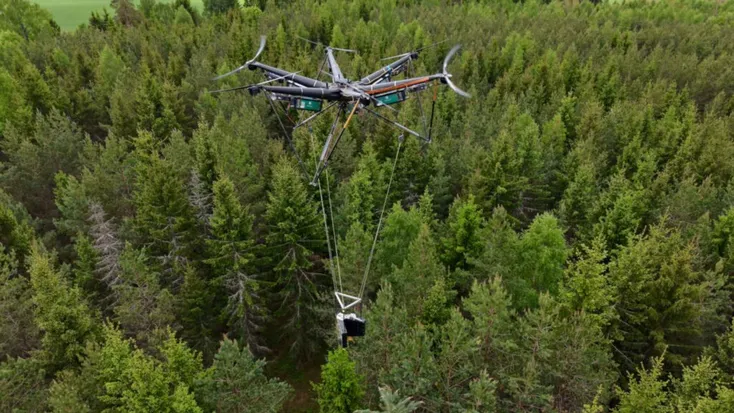
Logging has long held the grim distinction of being one of the most lethal occupations on earth. Now, a Swedish startup believes it has taken a meaningful step toward making the industry far safer — by removing human workers from the forest floor entirely.
AirForestry recently demonstrated an electric drone capable of autonomously harvesting trees in a live production forest, marking what the company describes as a significant milestone in forestry automation. The drone identified a target tree, stripped its branches, cut through the trunk, and transported the log — all without a human operator directly controlling its movements. The machine made those decisions and completed the full harvesting sequence on its own.
That distinction — full autonomy rather than remote operation — is central to what makes the demonstration noteworthy. Remote-controlled forestry equipment already exists, but a system that independently selects, processes, and delivers timber represents a qualitatively different level of technology.
Logging kills workers at 23 times the national average.
That statistic underscores the urgency of the engineering achievement. Removing human workers from the cutting zone is not merely a matter of operational efficiency; it is a potentially life-saving intervention in an industry that has resisted modernization far longer than most.
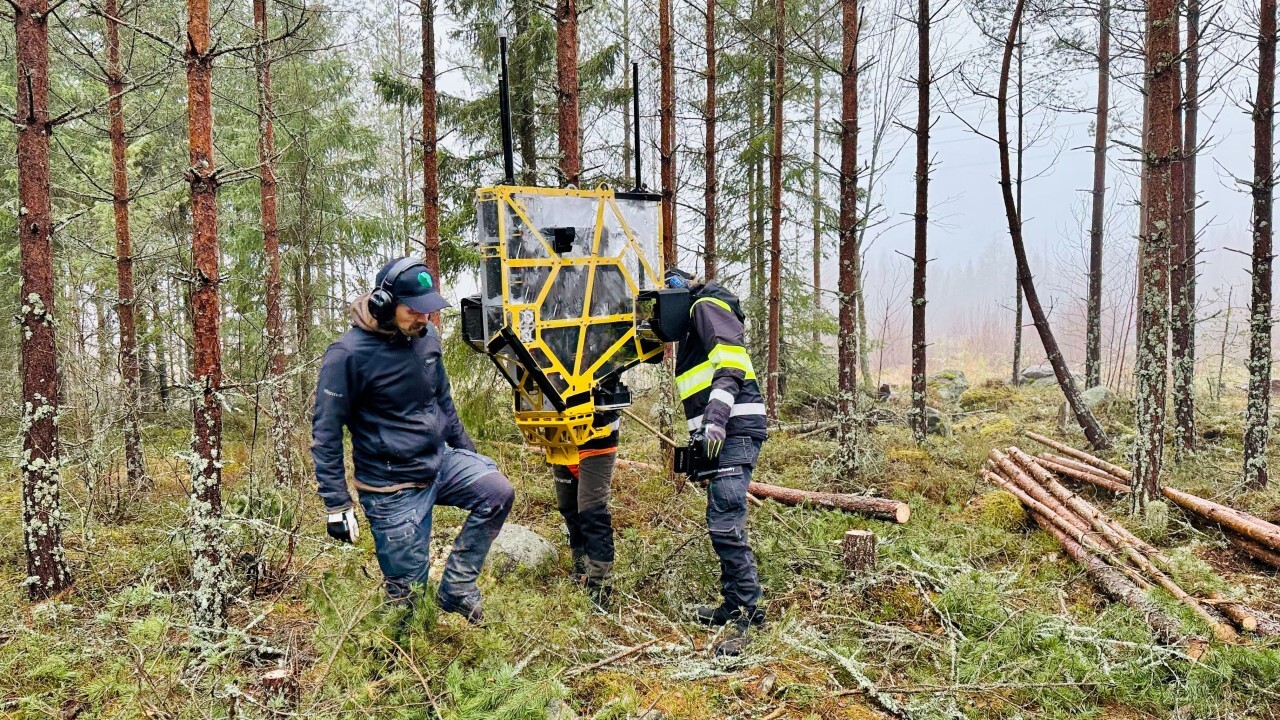
The implications of scalable autonomous harvesting extend well beyond worker protection. Conventional forestry machinery is enormously expensive and requires skilled operators, placing ownership out of reach for smaller landholders. A drone-based system could lower those barriers, reshaping the economics of timber harvesting and broadening access for smaller operations. Remote or difficult terrain that is currently uneconomical to log could also become viable, opening up timberland that geography and infrastructure costs have kept off-limits.
The forestry sector is also contending with a persistent labor shortage. Automation offers a path to meeting timber demand without drawing more workers into conditions that have historically proven deadly.
AirForestry's demonstration does not exist in isolation. Across industries, autonomous machines are moving from experimental status into active deployment. The U.S. Navy has deployed unmanned underwater drones to patrol the Baltic seabed, while unmanned vessels are being tested in maritime rescue operations. Australia, meanwhile, has brought its Ghost Shark autonomous submarine drone into operational service, signaling that large-scale, fully independent machines are no longer a distant prospect.
What these developments share is the same underlying logic: in environments that are dangerous, remote, or logistically challenging, removing the human operator from the equation is becoming not just possible but practical. For forestry workers, that shift may not come soon enough.