4 Jul 2026
,Russia
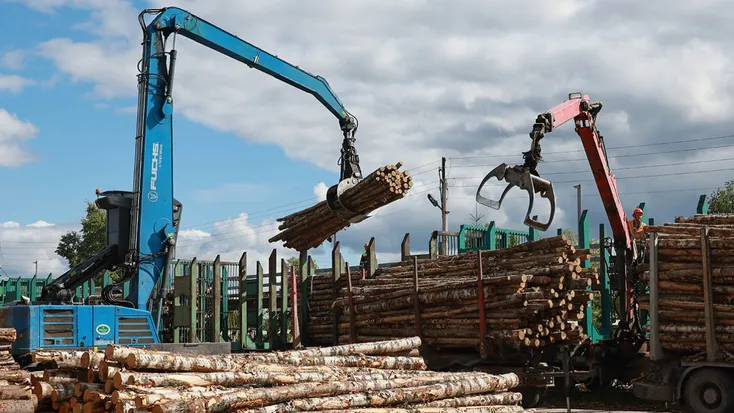
Russian timber, banned from import under European Union sanctions, continues to reach the Czech market — now disguised as legitimate goods from China. Czech authorities are aware of the issue and are conducting official inspections of several companies believed to be involved in schemes to bypass the restrictions.
Alerts have also come from the Baltic states, which warned Prague that a number of Czech importers are purchasing large volumes of Russian-origin timber. Siberian larch has become the main focus of suspicion — a species that grows exclusively in Russian Siberia and is virtually absent from other regions of the world.
Trade in Russian timber was banned by EU sanctions in 2022: export revenues directly replenish the Kremlin’s budget and finance military operations. Nevertheless, illegal supplies have not stopped — they have merely become more sophisticated.
The key tool for concealing the origin of the goods is the objective difficulty of identifying them. As market participants note, “it is extremely difficult to visually determine the exact origin of coniferous timber and distinguish it from Asian or Mongolian equivalents.”
Russian suppliers actively exploit this characteristic. Front companies are established in China to issue forged documents, through which the goods are legalized and then shipped onward to Europe. One major Czech timber trader confirmed that Russian partners directly offered to continue cooperation through such specially created Chinese firms. His company declined the scheme.
Statistics indicate the industrial scale of the activity. Official imports of larch from Russia to Czechia have fallen to zero — yet at the same time, shipments of the same timber from China have surged from several tons to hundreds of tons. In addition, suspicious consignments of larch have begun appearing at transit hubs in Serbia and Turkey, although the species does not grow in those countries.
The Czech timber case is only one of many episodes in a large-scale international phenomenon. Other schemes to evade restrictions imposed on Russia are being investigated in parallel.
The Turkish company Redwing Metal Uluslararasi Ticaret Anonim Sirketi organized the re-export of European metalworking machines and equipment intended for Russia’s military-industrial complex. In the United States, an employee of a freight-forwarding company was sentenced to one and a half years in prison for illegal deliveries of industrial equipment to Russia’s oil and gas sector. Swiss law-enforcement agencies carried out a large-scale operation against a network of financial intermediaries who helped Russian entrepreneurs move assets and evade sanctions. Finally, Ukraine’s Security Service uncovered a scheme through which Russia bypassed international sanctions and replenished its so-called “shadow fleet.”
Taken together, these cases indicate that evasion of the sanctions regime has long ceased to be a spontaneous phenomenon and has become a systematically organized activity spanning multiple countries and industries.