
yesterday at 12:29
,Germany
The Ukrainian timber market is experiencing an acute resource shortage: prices at auctions are rising, and all lots are being snapped up. At the same time, additional volumes of timber from windfalls are effectively not reaching the market — they remain in the forests and lose quality. Industry participants identify protracted and expensive permitting procedures, particularly environmental impact assessments (EIA), as the key obstacle.
According to wood processors’ estimates, the raw material shortage directly pushes prices upward and poses a threat to the stable operation of enterprises. At auctions, industrial pine has already sold for 6,600 UAH per cubic meter, while birch has reached up to 7,700 UAH per cubic meter.
The high demand is easily explained: without access to resources, enterprises are forced to cut staff or halt production. Businesses express readiness to increase processing and pay taxes but face a lack of raw materials.
Foresters, meanwhile, emphasize that resources are not limitless: annual harvesting limits, environmental regulations, and approved logging plans are in place. This is where the conflict arises — additional timber from natural disasters exists, but it does not make it to the market.
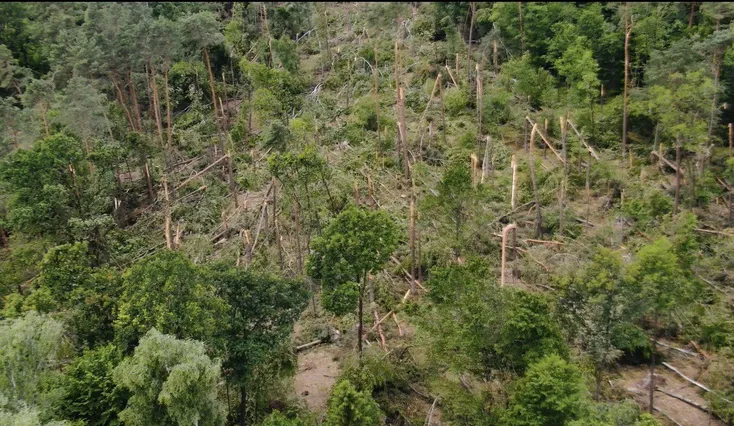
A striking example is Rivne Oblast. After a windfall, over 700 hectares of damaged forests were recorded, with more than 200 hectares of tree stands almost completely destroyed and requiring clear sanitary felling. According to industry estimates, prompt clearing of these areas could provide the market with tens of thousands of cubic meters of additional timber.
Attempts to expedite the work by declaring the situation an emergency have yielded no results. One of the reasons cited is the lack of an approved methodology for calculating damage to forests affected by windfalls and storms.
The main constraining factor, according to market participants, is the EIA procedure. The assessment is mandatory if the area of clear sanitary felling exceeds 1 hectare. The procedure is described as lengthy and costly: in some cases, its cost has exceeded 500,000 UAH.
Critics point out that this logic leads to an absurd situation where addressing the aftermath of a natural disaster requires significant time and financial expenditure. As a result, timber from windfalls does not reach the market and remains in the forest.
Delays directly affect the quality of the resource. Within just a few months of waiting, the share of industrial timber sharply declines: high-quality wood turns into firewood, which is worth several times less. For pine, this process is particularly critical — within 2 months, the share of usable timber can drop to nearly zero.
This translates into losses for forestry enterprises and local budgets, exacerbates shortages at auctions, and adds pressure on wood-processing companies. Attention is also drawn to the safety aspect: fallen timber that is not cleared for a long time increases fire risks near populated areas.
The industry has been calling for changes in regulation for years — a call echoed by businesses, communities, and local authorities. The government has announced preparations for solutions, but it remains unclear when these will move into practical implementation.