6 Jun 2026
,France
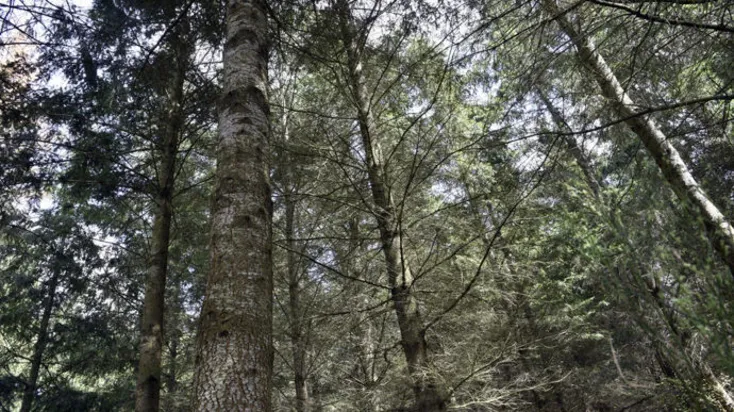
In 2025, the average price of standing timber stands at 86 euros per cubic meter, a level that confirms the market’s lasting position above its pre-Covid benchmarks. This figure, derived from transactions carried out in private forests, is of particular significance: private forests account for 75% of the 17 million hectares of metropolitan French forest, making this indicator a key barometer for the entire sector.
Behind this average, however, lie highly contrasting trends depending on species. The market is now deeply divided between softwoods supported by sustained demand and hardwoods in clear decline, weakened by a series of sectoral shocks.
Oak records its third consecutive decline, falling 17% to 190 euros per cubic meter, far from its record of 271 euros reached in 2022. The main driver of this drop is the wine-sector crisis, which is reducing demand for stave wood used in barrel production, while stocks accumulate at cooperages.
Beech, for its part, drops 12% to 49 euros per cubic meter. Its decline is largely due to competition from South American eucalyptus, which is increasingly favored by the Chinese furniture industry at the expense of European woods. Chestnut has not been spared either: it plunges 18% to 97 euros per cubic meter, hit by the slowdown in the French construction market and its continued heavy reliance on the Italian outlet.
Ash stands out as a relative exception among hardwoods, with a slight 2% decline to 155 euros per cubic meter. This near-stability is nevertheless explained by the caution of Vietnamese buyers, who are curbing their purchases amid the risk of new U.S. tariffs, casting uncertainty over the sustainability of this price level.
In contrast to this trend, softwoods are benefiting from robust demand, driven in particular by the structural timber sector. Douglas fir, the flagship species of this dynamic, rises 4% to 93 euros per cubic meter, following an already spectacular 24% increase in 2024. Its higher price is prompting sawmills to turn to other conifers, triggering a broad upward effect on prices across this category.
Norway spruce illustrates this mechanism strikingly: its price jumps 28% in 2025 to reach 69 euros per cubic meter. This surge is the delayed consequence of the massive sanitary fellings carried out between 2018 and 2022 to contain bark beetle attacks, which created a lasting shortage of whitewood on the market. Silver fir and Corsican pine are also benefiting from this supply-demand imbalance.
In terms of volumes, 38 million cubic meters of timber were marketed in France in 2024, two-thirds of which came from private forests. This figure reflects a steady downward trend since the peak of nearly 40 million cubic meters reached in 2021.
The French timber sector also remains structurally in deficit. Its trade balance stood at -7.8 billion euros in 2024, a concerning figure but an improvement compared with the -9.5 billion euros recorded in 2022. France mainly exports raw timber while importing large volumes of paper, cardboard, and furniture. Although imports of sawn timber have decreased in recent years, the path to balance remains long for a sector that still struggles to process its own resource locally.