
today at 10:58
,Romania
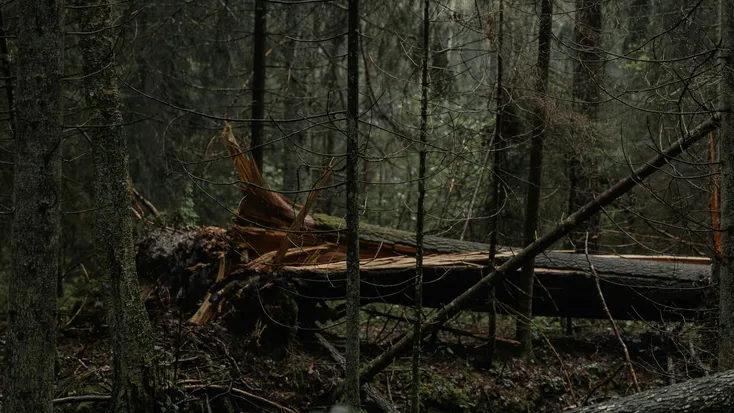
After storms and squalls, forests are often strewn with fallen trees. Many people are tempted to take such wood for firewood — after all, it is already lying on the ground. However, the law does not provide grounds to consider this an innocent act.
According to the Forest Code of Ukraine, any timber in the forest is a forest resource and belongs to the state or the permanent forest user. Trees felled by storms are no exception — taking them without authorization is prohibited. The harvesting of windfallen and other damaged timber is to be carried out by forest enterprises, not by ordinary citizens. This is also linked to practical safety considerations: logging operations are hazardous and, without proper training and equipment, can pose a direct threat to life.
There is another aspect to the issue. Under the guise of collecting windfallen timber, some individuals illegally cut down trees that have not been damaged by the weather at all. This is why control in this area is especially important.
Without special permits, only fallen leaves, needles, bark, small twigs, and branches up to 3–5 centimeters in diameter may be collected in the forest. If a person wishes to legally take a fallen tree for firewood, they must obtain a logging permit from the permanent forest user — usually the local forestry enterprise.
Collecting deadwood or any other timber without the appropriate documents may be classified as illegal logging with all the associated legal consequences.
Under Article 64 of the Code of Ukraine on Administrative Offenses, violation of the rules for using the logging fund and harvesting timber is punishable by a fine of 102 to 238 hryvnias for citizens and 170 to 272 hryvnias for officials. Article 65 of the same Code provides stricter sanctions for the illegal felling, damage, or destruction of forest plantations and young growth: citizens may be fined from 510 to 1,020 hryvnias, and officials from 2,550 to 5,100 hryvnias.
If significant damage is caused to the forestry enterprise, the offender may be held criminally liable under Article 245 of the Criminal Code of Ukraine. The penalty includes a fine of 17,000 to 25,500 hryvnias or restriction of liberty for up to three years. In addition, the offender is obliged to compensate for the damages caused, which often far exceed the amount of the fine itself.
The rules regarding trees differ significantly depending on where the plantation is located. Owners of private houses may independently decide which trees to cut on their household plots — the owner or land user has the right to determine the timing and necessity of such work at their own discretion.
A different situation applies near apartment buildings. The adjacent territory is not the private property of individual residents but belongs to the community, so unauthorized tree felling there is prohibited. Any work involving plantings in such areas requires appropriate approval.
Trees outside private plots — particularly on streets and in public spaces — also cannot be removed without permission. Decisions on cutting such plantings are made by the executive committee of the city, settlement, or village council, and permits must be obtained there.