
26 May 2026
,Latvia
In 2024, Latvia ranked third in the world in terms of per capita revenue from the export of prefabricated wooden buildings. The industry’s performance stands out in the Baltic context, where neighboring countries maintained leading positions globally, while also reminding us that the concept of portable, quickly assembled dwellings is not new to Latvian territory.
However, in terms of total volume, Latvia’s figures are more modest: the country’s revenue from prefabricated wooden building exports in 2024 reached 47 million euros, securing eighth place worldwide. Yet, when recalculated per capita, Latvia climbed to third place globally with 25 euros per inhabitant.
In 2024, the Baltic region demonstrated clear leadership in the prefabricated wooden building segment: Estonia was the world’s largest exporter of such buildings, while Lithuania ranked second. Latvia lagged behind both neighbors in terms of volume but achieved one of the highest per capita figures globally.
Latvia’s competitiveness is further illustrated by comparisons with larger markets: Latvia surpassed several countries, including the USA, where export revenue from prefabricated wooden buildings in 2024 was 30 million euros, or 1.7% in relative terms.
Export markets in 2024 were concentrated in Northern and Western Europe. Latvia’s primary market for prefabricated wooden buildings was the Netherlands (20.8%), followed by Norway (17.2%), Iceland (12.4%), and Germany (11.2%). Further down the list were Sweden (5.4%), the United Kingdom (5.3%), and the USA (3.1%). This geographical distribution reflects regions with a traditional high use of timber in construction, as well as a demand for quickly implementable projects.
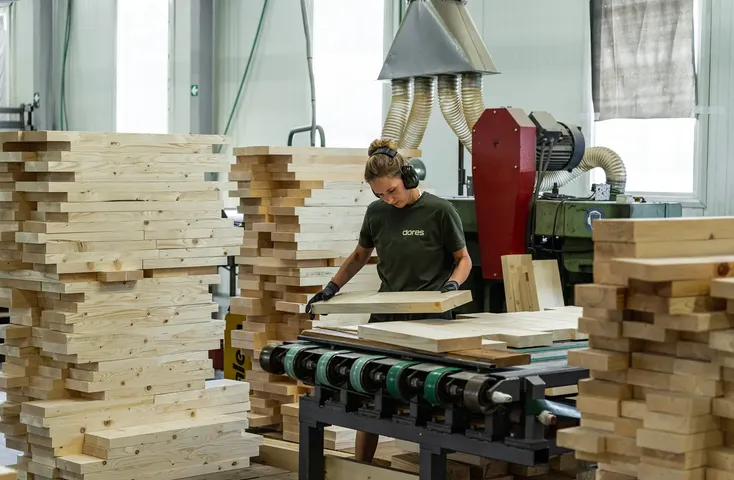
The product category CN 940610 includes prefabricated wooden building structures. The principle is simple: prefabricated buildings are manufactured in factories and then assembled on-site, usually within a few days or weeks. This reduces construction time, improves quality control, and allows for more precise cost and logistics planning.
Buyers use these solutions for various purposes: single-family homes, summer cottages, apartment modules for high-rise buildings, student and visiting professor accommodations in university dormitories, temporary housing for medical staff in field hospitals, as well as retirement homes and patient villages. Prefabricated wooden structures are also used as commercial spaces—small office buildings, retail outlets, and other public infrastructure.
The crisis response dimension is also significant: prefabricated wooden houses are often used in disaster relief, temporary housing for refugees and asylum seekers, and, in some cases, for military purposes. Such structures are also in demand in workplaces with extreme climatic conditions and for scientific research expeditions in the Arctic and Antarctic.
At the same time, industry limitations are also emphasized: it is noted that the operational lifespan of such structures can be up to 15 years, although in practice, this depends on the materials used, maintenance, and environmental impact.
The idea of portability has deep roots in Latvia’s building traditions. Historically, the first human-made dwellings were structures that could be easily disassembled and transported. One of the earliest shelters for Latvians was the pole hut—a lightweight structure that could be dismantled and, if necessary, relocated. Another early building type was the log cabin—a structure made of unhewn logs that could similarly be taken apart and moved. Over time, construction gradually became “tied” to specific locations: planks started being used in building relatively recently, while in forested areas, log construction dominated until the 20th century. By the late 19th century, log cabins were no longer built for residential purposes, and from the early 20th century, homes were predominantly constructed for specific sites.
Industrial production in the prefabricated wooden building segment in Latvia began in the second half of the 20th century: initially, garden houses were produced industrially, with volumes fluctuating (for example, 7,300 square meters in 1970, and 4,000 square meters in 1988), and production was based on pre-orders.
The most recognizable symbol of the Soviet era became prefabricated residential houses made from particleboard, widely known as “Līvāni houses.” Their production started at the end of 1977; the factory produced approximately 1,000 houses per year, totaling just over 10,000 prefabricated homes. However, one of the major issues with these houses was fire safety, and several devastating fires were directly linked to “Līvāni houses.” Today, finding an untouched and unrenovated “Līvāni house” in rural Latvia is practically impossible.
After the restoration of independence, a significant shift occurred: house production ceased in 1993, and in 1994, the factory was split into 12 different companies through privatization. Subsequently, the industry’s growth was driven by the potential of the timber industry and a reorientation toward high-value-added wood products—many woodworking companies began producing prefabricated wooden houses and specializing according to client needs.
Today’s results in global statistics reflect this continuity: a long-standing tradition of portability, industrialized production, and niche specialization that helps maintain a presence in the global market. In 2024, Latvia ranked third in the world in per capita revenue from the export of prefabricated wooden buildings.