

14 Jun 2026
,Latvia
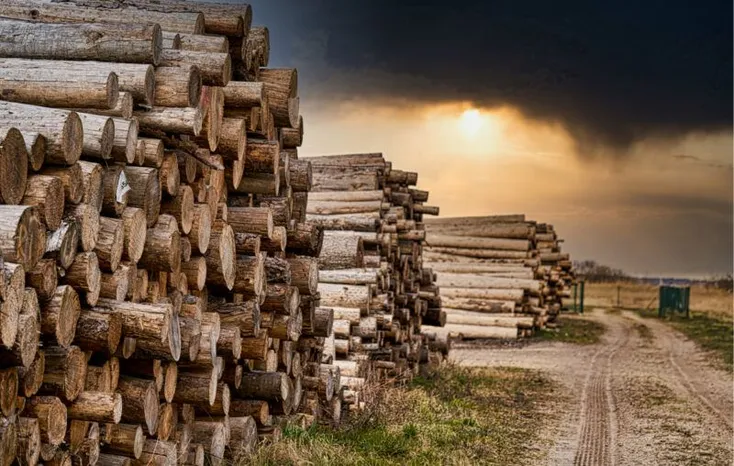
Forest-derived products occupy a central place in Latvia's economy, accounting for at least 5% of GDP and roughly one-fifth of the country's total exports. Yet the sector faced a significant setback in late 2025, as Latvian exports to the United States fell sharply, exposing the industry's vulnerability to shifts in American trade policy and construction demand.
In December 2025, Latvia's total exports to the US declined by 44% compared with the same month in 2024, reaching just 27.9 million euros. The primary driver of that contraction was a steep drop in wood and wood-derived products, including charcoal, which fell by 15.4 million euros — a decline of 86.4%. Over the full year, Latvia's exports of wood and wood products to the US dropped from 148 million euros in 2024 to 105 million euros in 2025.
Kristaps Klauss, Executive Director of the Latvian Wood Industry Federation (LKF), pointed to two overlapping causes.
"This was caused by both tariffs, which significantly increased the competitiveness of US manufacturers against European products, and the generally weak construction market in the US." — Kristaps Klauss, LKF Executive Director.
The impact of the downturn was not felt equally across all wood-product categories. Exports of softwood boards, for instance, actually increased despite the broader decline. The sharpest losses were recorded in particleboard and, in particular, Oriented Strand Board (OSB) — a low-cost engineered wood material widely used in residential construction and therefore highly sensitive to conditions in the American housing market.
Latvian companies are actively seeking alternative markets, though replacing the United States is proving difficult. Klauss argued that tariffs are fundamentally reshaping global trade flows and forcing all parties to search for a new equilibrium. Latvia's position is somewhat cushioned by the fact that Europe remains the primary destination for its wood exports, meaning the country is affected less directly than some of its competitors.
Kārlis Purgailis, an economist at Citadele Bank, noted that Latvian wood exports to the US have historically been highly volatile. That pattern became especially pronounced in 2025, when monthly figures swung dramatically — from 17.31 million euros in May to just 2.9 million euros in August. A temporary recovery to 10.49 million euros was recorded in October, but November and December again produced weak results of 2.16 and 2.42 million euros respectively. Comparably low monthly volumes had previously been seen in December 2021 and January 2023.
Despite the turbulence, the US has in stronger periods ranked among the top ten export destinations for Latvian wood products, underscoring its continued strategic importance to the sector.
"Consequently, the chaotic and unfriendly international trade policy of the United States significantly affects the woodworking industry, which is important for Latvia." — Kārlis Purgailis, Citadele Bank economist.
At the end of September 2025, President Donald Trump announced new tariffs of 10–15% on timber and wood products, directly affecting Latvian producers. The stated rationale was to reduce the US trade deficit and strengthen the competitiveness of American manufacturers by raising barriers against foreign suppliers. Beyond their immediate economic impact, Trump's tariff announcements have also been widely interpreted as broad political signals — instruments of pressure extending well beyond the realm of trade itself.