yesterday at 10:29
,Ukraine
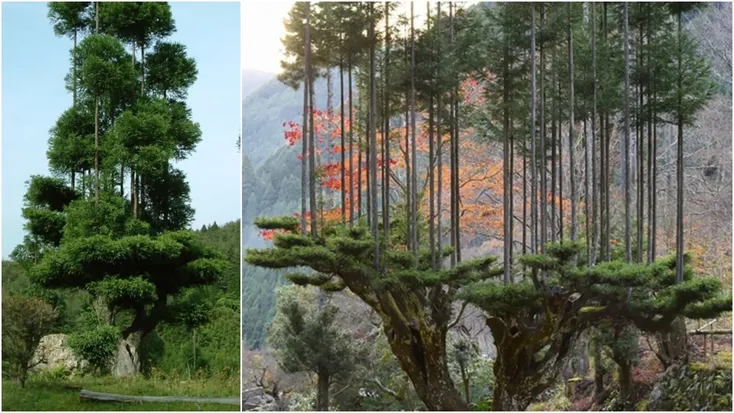
Daisugi is a traditional Japanese tree cultivation technique dating back to the Muromachi period, between the 14th and 16th centuries, and developed in the Kitayama area near Kyoto. The name derives from the sugi tree, a species of Cryptomeria japonica, better known as Japanese cedar, which remains closely associated with this method. What makes daisugi special is not only the cultivation technique itself, but also the philosophy behind it: obtaining high-quality timber without felling the entire tree.
The technique arose from practical necessity. Traditional Japanese architecture required wood with precise characteristics — straight, uniform, and aesthetically valuable. In Kitayama, where land was limited and demand for quality timber was high, a unique approach emerged: the parent tree is carefully pruned so that upright, slender, and straight shoots grow from the upper platform. These shoots are eventually harvested and used as timber, while the base of the tree and its roots remain alive, continuing to nourish new growth.
Wood obtained through this method is valued for its regular shape, straight growth, and fewer knots, making it ideal for precision construction. It was especially used by builders of traditional Japanese tea rooms, where appearance, quality, and material proportions were of critical importance.
Daisugi is often compared to pollarding and coppicing techniques known in European forestry traditions. However, what distinguishes it is the specific shaping of the tree into a platform from which new shoots grow, turning the entire process into an almost sculptural practice. For this reason, daisugi is sometimes described as a large-scale bonsai applied to forestry — a metaphor that precisely captures the combination of patience, skill, and aesthetic awareness this technique demands.
Over time, daisugi has transcended its primarily economic function. Due to the unusual and striking appearance of trees cultivated with this method, they are increasingly featured in Japanese gardens as aesthetic landscape elements. The straight, narrow shoots that rise like arrows from the rounded base give gardens a unique visual rhythm.
Although daisugi no longer holds its former industrial significance in mass timber production, it has not been forgotten. In northern Kyoto, active efforts are underway to preserve this method, along with the traditions of processing and polishing Kitayama sugi wood, which form part of the region’s distinctive heritage.
Ultimately, daisugi represents more than a forestry technique. It is an example of how resources can be used carefully and thoughtfully, how nature can be shaped without being destroyed, and how tradition can be both functional and beautiful. This is why this ancient Japanese method continues to attract attention far beyond the borders of Kyoto.