1 Jun 2026
,France
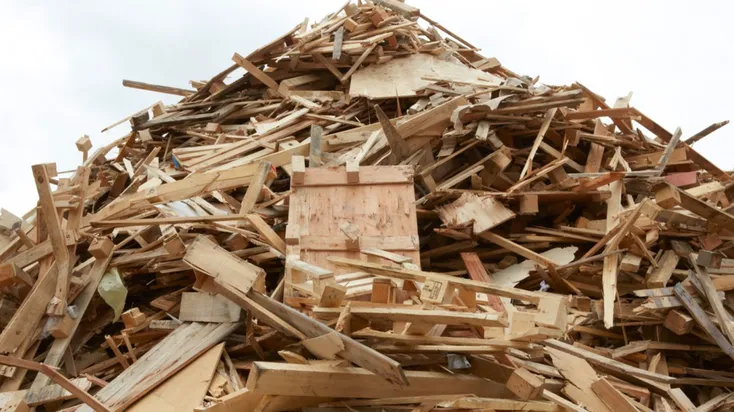
The implementation of the REP PMCB (Extended Producer Responsibility for building construction products and materials) has significantly boosted sorting on construction sites… while producing an immediate downstream effect. The volumes of collected wood waste have risen rapidly, to the point of putting significant pressure on recovery channels.
"Today, our wood recovery channels are saturated," summarizes an industry stakeholder, noting that "the REP encourages sorting, but the outlets are not yet equipped to handle such volumes."
In several regions, operators report flows deemed "enormous" and an absorption capacity struggling to keep up with the pace.
In France, wood waste accounts for approximately 7.4 million tons collected each year. Nearly a third—about 2.5 million tons—comes from the construction sector. Despite sorting progress, around 1.6 million tons are still landfilled, a volume described as a real "waste" by professionals. For the industry, the situation feels like déjà vu: after the introduction of the REP DEA (furniture), the wood recovery market had already become saturated, with outlets unable to absorb the influx of materials for several years.
On the ground, the REP PMCB has clearly accelerated the organization of sorting, particularly in deconstruction activities and for carpentry.
"Now, building industry players are organizing to sort," operators observe, noting that within three years, sorting has become almost systematic among certain stakeholders.
Direct consequence: significantly larger volumes are entering preparation and processing circuits.
The main point of tension concerns "wood B" (furniture, windows, wood from various uses), a heterogeneous and technically more complex stream to manage. Several stakeholders describe a sector "flooded with wood B that we don’t know what to do with," mentioning quantities deemed "staggering." Eco-organizations confirm this rapid increase in collections: one of them reports having collected 250,000 tons of wood waste by September, compared to 120,000 tons over the same period the previous year.
At this stage, the recovery of collected wood relies mainly on two outlets. Of the approximately 5.8 million tons of wood waste considered "properly recovered," 3.2 million tons supply the wood panel industry and pallet manufacturing. Energy recovery, on the other hand, accounts for 2.6 million tons.
In the medium term, prospects hinge on a significant capacity increase by 2028, particularly on the energy side. Recycling capacities could nearly double, while energy recovery capacities could reach 5.6 million tons. In the panel industry, the trend is already toward greater integration of recycled wood: factories reportedly purchase about 20% more recycled wood each year, gradually moving away from forest wood.
However, a major unknown remains: final demand. The European and French market for particleboard furniture does not currently show sufficiently dynamic growth to guarantee the sustainable outflow of ever-increasing volumes.
The most dynamic driver appears to be energy, with numerous projects for converting heating systems, particularly from fuel oil to wood. Project leaders highlight lower emissions within a strict regulatory framework (classified installations, specifications). But a paradox looms: if too many projects come to fruition simultaneously, the sector could face overcapacity, with "more projects than actually available wood streams."
Another sensitive issue: the location of outlets. Of the recovered volumes, about 33% are reportedly exported, due to insufficient national solutions or, more often, because the nearest outlet is across the border.
Some professionals cite situations where "the closest outlets are in Spain."
Operators note, however, that these flows are mostly directed toward neighboring countries, with Sweden mentioned as marginal, accounting for less than 1% of exports.
In this context, the economic functioning of the REP is subject to criticism. Some stakeholders believe that exported flows should remain in France and accuse the system of facilitating international departures by covering transport costs to the outlet.
"The REP undermines our work because it makes transport to the outlet free, regardless of its destination," claims one stakeholder, citing the extreme case of a shipment "to Sweden" funded by the REP.
Eco-organizations and several operators temper these statements, emphasizing the primarily "local" nature of exports.
The sector also relies on a key link: preparation. Around 120 facilities in France handle sorting and adaptation of wood to the specifications of outlets, whether French or foreign. This organization does not prevent rising economic tensions: prices are described as highly variable across regions, higher in the Northeast, and continuously increasing for end-of-life construction wood waste. The expected rise in energy demand could exacerbate these tensions.
Ultimately, the REP PMCB has undeniably accelerated sorting and enabled the recovery of volumes previously scattered—or even landfilled. But the sector still needs to catch up on the outlet side, both in recycling and energy, and strengthen its territorial network. Failing that, capacity saturation, default exports, and rising prices risk becoming entrenched.