

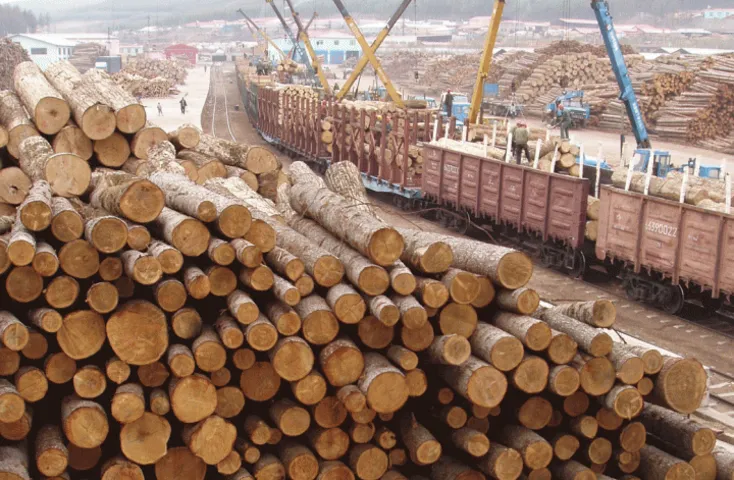
China's significant reduction in timber imports for 2025 is increasing pressure on the international timber market to readjust prices, volumes, and supply strategies. Analysts suggest that this decline is driven by a slowdown in domestic construction demand, coupled with changes in trade flows and rising costs and regulatory burdens. However, with a rebound in monthly imports in September, whether this marks a phase of 'stabilization' or merely a temporary adjustment has emerged as a key point of focus for the future market.
Imports of softwood lumber, a key indicator of China's construction timber demand, have seen declines in both volume and value. In the first half of 2025, softwood lumber imports dropped by approximately 18% year-on-year to 7.32 million cubic meters, with import value decreasing by 17%. On a cumulative basis from January to September, lumber imports totaled 18.34 million cubic meters, a decline of about 12%, while the import value fell by 11% to approximately $4.776 billion. This is interpreted as a sign of weakening construction-driven demand in China.
Log imports are also showing a clear downward trend. From January to September 2025, log imports amounted to about 23.96 million cubic meters, a 13% decrease compared to the previous year, with import value dropping by 22%. The larger decline in value compared to volume suggests the possibility of falling unit prices or price pressures.
A contraction is also evident in the composition of timber species. While the proportion of softwood remains high in total log imports, both softwood and hardwood imports have declined. During the same period, softwood log imports were recorded at 12.34 million cubic meters, and hardwood log imports at 4.45 million cubic meters. The slowdown in softwood is seen as a direct burden on the international construction timber market, which is closely tied to Chinese demand.
The most immediate reasons for the decline in imports are attributed to the slump in China's real estate market and the slowdown in construction activity. Weakness in key indicators such as new construction starts and pre-sales has led to reduced timber purchases, which in turn results in lower imports. Additionally, changes in trade flows and supply chain adjustments are altering import patterns.
For instance, imports of U.S. logs have effectively ceased since March 2025. In contrast, volumes from alternative supply sources such as New Zealand, Japan, and Latvia have increased. While imports from Japan have shown an upward trend, those from the U.S. have plummeted, leading to interpretations that the diversification of supply countries may signal a structural shift beyond mere substitution. However, further confirmation is needed to determine whether the halt in U.S. imports is primarily due to policy and regulatory issues, pricing conditions, logistics, or changes in bilateral trade relations.
Imports of hardwood logs, primarily tropical timber, and timber products for export have also significantly decreased. The reduction in construction demand within China is shrinking tropical timber imports, which in turn reflects adjustments in exports from related supplying countries. Nations heavily reliant on tropical timber may face increasing pressure to redistribute volumes and diversify sales channels.
Amid the declining trend, the 15.9% month-on-month increase in import volume for September 2025 has drawn market attention. Some view this as a sign of stabilization at a certain level, driven by demand for inventory replenishment. However, on a cumulative annual basis, both import volume and value remain lower than the previous year, leading to a prevailing view that it is premature to interpret the September rebound as a trend reversal.
Overall, China appears to be shifting its strategy away from absorbing large volumes of overseas timber as in the past, instead reducing imports while diversifying supply sources. This inevitably leads to changes in the structure of the international timber market, with supplying countries facing the simultaneous challenges of adjusting pricing policies, controlling volumes, and exploring alternative markets.
Key variables that will shape future trends include timber price movements, the potential recovery of China's real estate and construction sectors, and changes in the international trade environment. Whether the September rebound is a temporary adjustment or a signal supporting a 'bottoming out' theory will depend on the development of these factors.