1 Jun 2026
,Germany
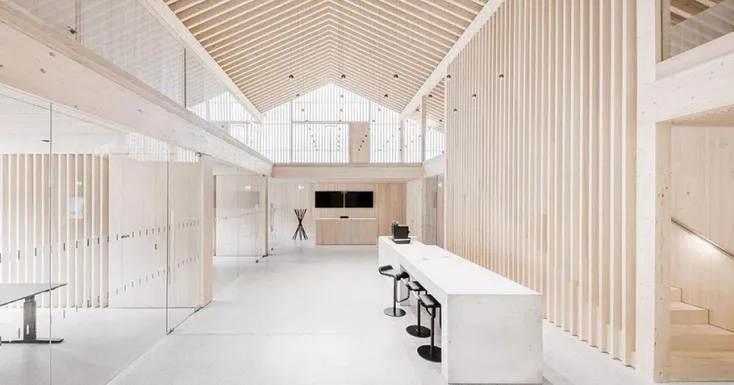
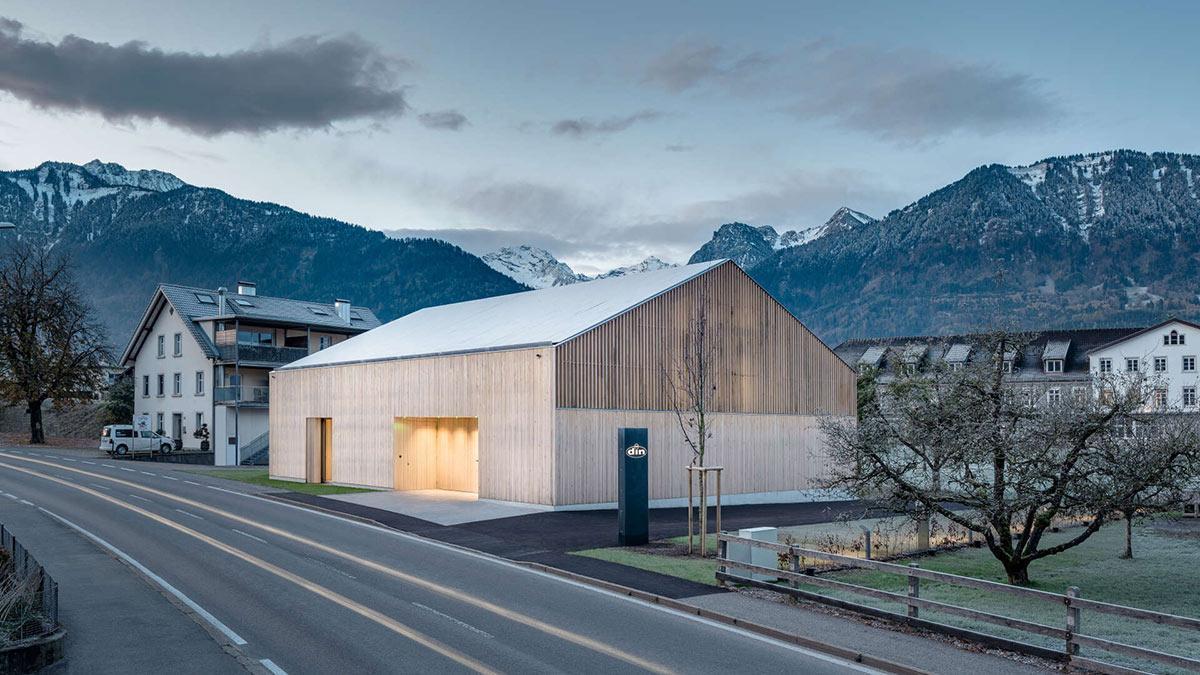
In the idyllic municipality of Schlins in Austria’s Vorarlberg region, a remarkable new building has recently emerged. The new office complex of DIN Sicherheitstechnik, a renowned family-owned company from Linz, sets standards for minimalist design – and does so without the often typical concrete or plain white surfaces. Instead, the choice fell on an award-winning engineered timber structure that serves equally as a practical toolbox and an elegant showroom.
The client, a proponent of efficient working environments, had clear ideas: the new premises should function like a toolbox, providing the best possible conditions for him and his employees to carry out their work. This concept was masterfully implemented by architect Markus Thurnher and his firm Fink Thurnher Architekten. Their design combines functional requirements with aesthetic sophistication, seamlessly integrating order, efficiency, and an inspiring work atmosphere into the daily operations of DIN Sicherheitstechnik.
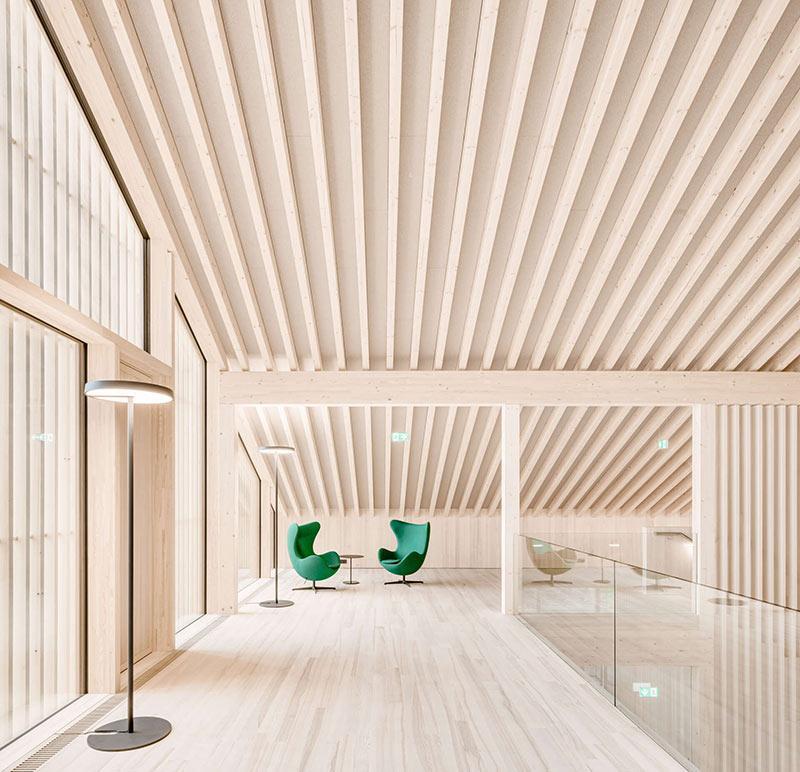
A look inside the building reveals how the concept of efficiency has been realized. Clear structures and a functional layout of the spaces not only simplify daily work but also contribute to the positive work culture that the company promotes. The architecture provides room for creativity while ensuring clear organization, allowing employees to fully focus on their core tasks.
The decision to use wood as the primary building material is more than just a design finesse. Wood promotes a natural, healthy indoor climate, which is particularly valued by the employees. Moreover, the choice of material reflects the company’s sustainable philosophy, which also focuses strongly on safety and responsibility in its core competency – the development and production of emergency and safety lighting.
This new branch is already the fifth in Austria and underscores the company’s expansion strategy. Vorarlberg, with its growing economy and high quality of life, offers an ideal location. For DIN Sicherheitstechnik, the new building in Schlins represents not only an expansion of its geographical footprint but also an important step toward future-oriented workplace design that meets the company’s high quality standards.
In summary, the building in Schlins is more than just an office. It is a symbol of modern working in harmony with sustainability and efficiency. The appealing architecture, functional construction, and intelligent use of wood as a structural element set new standards in today’s and tomorrow’s working world. This impressively demonstrates that minimalism does not necessarily equate to starkness but can instead create a harmonious interplay of form and function.