yesterday at 12:29
,Germany
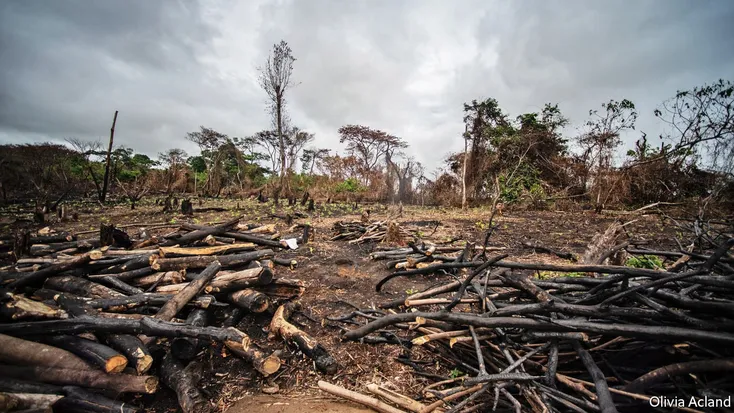
Massive deforestation and damage from mining have turned the rainforests of the Democratic Republic of Congo from carbon sinks to carbon sources, according to a study published in the journal Scientific Reports. Africa’s forests and shrublands were once among the world’s largest CO₂ sinks, accounting for about 20 percent of the total carbon dioxide absorbed by plants.
The Congolese rainforest, the second largest after the Amazon, used to absorb about 600 million tons of CO₂ annually. But large-scale deforestation and the effects of mining have caused this figure to decline sharply. According to the study, African forests lost an average of 106 million tons of biomass annually between 2011 and 2017, which is equivalent to about 200 million tons of CO₂ emissions per year. The small increase in shrub biomass on the savannahs has not been able to compensate for these losses. As a result, Congolese forests now emit more CO₂ than they absorb, complicating global efforts to reduce net emissions.
Professor Heiko Balzer of the University of Leicester and his team estimated the amount of biomass using satellite data on the colour, humidity and height of tree crowns in selected areas, comparing the results with field measurements. The study did not take into account wet peatlands, which store around 30 billion tonnes of carbon and absorb small amounts of CO₂. The loss of forests’ ability to absorb carbon dioxide means that fossil fuel emissions will have to be further reduced to achieve carbon neutrality.
A similar situation is observed in the Amazon, which in recent years has also begun to emit more CO₂ than it absorbs, although government restrictions on logging there are more effective. In the Congo, deforestation continues to increase: poor farmers burn forests to make way for crops, and companies with foreign capital illegally cut down valuable tree species.
In response to the global threat, Brazil announced the creation of the Tropical Forests Forever Facility, which pays tropical countries compensation of $4 per hectare of forest saved. So far, the fund has received only $6.6 billion of the $25 billion it was committed to.
The loss of the Congolese forests' ability to absorb carbon dioxide is a global wake-up call. Protecting these forests, combined with reducing fossil fuel emissions, is a key element in the fight against climate change.