
yesterday at 12:29
,Germany
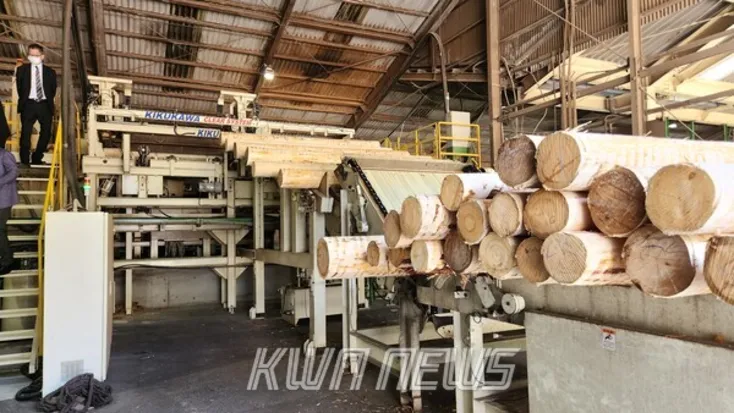
Over the past decade, Japan has fundamentally restructured its timber industry around the pillars of 'advanced technology, regional decentralization, and high value-addition.' As the large-scale artificial forests planted in the 1960s and 1970s reached maturity, leading to a significant increase in the supply of domestic coniferous timber, Japan pursued automation in processing stages such as sawmilling, plywood production, LVL, and CLT, while reorganizing supply chains at the regional level. As a result, Japan is regarded as having one of the most organized timber supply systems and technology-intensive production bases in Asia. For Korea, this serves as an important reference case, demonstrating that a market can be formed when 'timber resources, industry, and policy' are organically integrated.
Japan's forest area spans approximately 25 million hectares, with more than half consisting of artificial forests, predominantly coniferous species such as sugi (Japanese cedar) and hinoki (Japanese cypress). Notably, sugi plantations from large-scale afforestation efforts have reached their harvestable age, entering a 'sustainable harvesting period' that ensures a stable supply for the next 30 years or more, according to assessments.
Domestic timber production is currently estimated at 33 to 35 million cubic meters annually. Considering Japan's total timber usage is around 74 million cubic meters per year, the self-sufficiency rate for domestic timber stands at approximately 45%. This figure has steadily risen from 28% in 2010, and the Japanese government has set a target of achieving a 50-55% self-sufficiency rate by 2030. Analysts suggest that this success is due to policies and investments that have absorbed the increased supply not as 'excess logs' but as opportunities for 'standardization and advancement of the processing industry.'
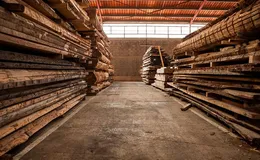
One of the core pillars of Japan's timber industry is the regional industrial cluster, often referred to as a 'wood cluster.' Processes such as log collection, transportation, marketing, processing, and drying are operated within a circular structure in specific regions, reducing log collection costs and ensuring consistent quality. The integration of sawmilling, drying, laminating, plywood production, LVL, and CLT processes within these regions has solidified benefits such as reduced logistics costs and enhanced production efficiency.
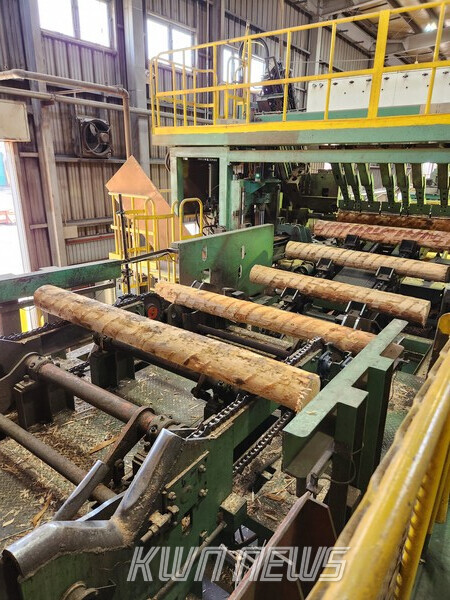
Another key pillar is the automation of the entire production process and the adoption of AI-based scanning technologies. A central aspect of Japan's strategy is minimizing industrial variability by setting small- and medium-diameter timber as the 'standard raw material.' Major factories in Japan use logs with a diameter of around 22 cm as their baseline material. This system is designed to ensure stable production of structural materials using standardized raw materials, even in cases of limited large-diameter timber or significant regional variations.
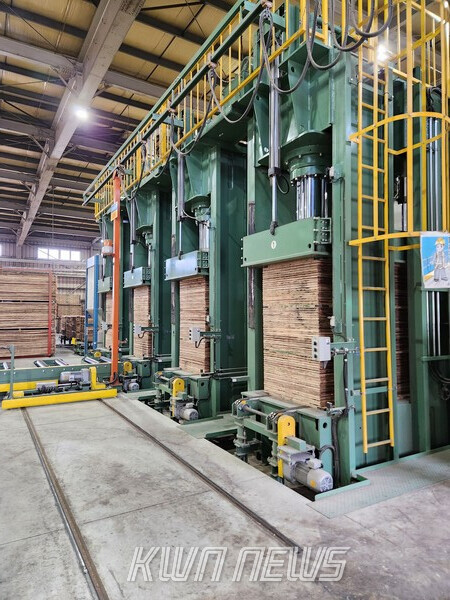
Technologically, mechanization and AI integration have spread across all processes, including 3D log scanning, automated cutting, veneer strength scanning (MOE/MOR), automated arrangement, and automated hot pressing. This not only increases yield but also standardizes quality. In particular, veneer arrangement technology in LVL production is highly regarded for its precision in selection and placement, which significantly impacts product performance. Glulam has secured stable demand, primarily in schools, gymnasiums, and public facilities, while LVL plays an 'invisible backbone' role in Japanese architectural structural materials. CLT, too, has shown a trend of expanding into both public and private sectors following the enactment of related promotion laws.
The most distinctive feature of Japan’s timber policy is its legal systematization. Laws such as the "Timber Utilization Promotion Act" (2009), the "Promotion Act for Structural Engineered Wood like CLT" (2016), the "Forestry Management Act" (2019), and the "Public Wooden Building Development Act" (2021) have progressively linked the expanded use of domestic timber, improved efficiency in forestry management, demand creation through public construction, and the establishment of regional circular systems.
The core of these policies can be summarized in four points. First, the institutional expansion of domestic timber use in public construction creates initial demand, targeting government offices, schools, libraries, welfare facilities, and gymnasiums. Second, fire resistance, structural, and joint standards, along with certification systems, have been refined to enable medium- and large-scale wooden construction, with prerequisites for scaling up—such as CLT fire certification, vibration testing, and joint standardization—becoming key policy agendas. Third, support for regional drying and sorting centers has reduced quality variations and stabilized the supply base for structural materials. Fourth, integrating carbon storage and LCA (Life Cycle Assessment) data into public procurement evaluations has combined climate policy with procurement, reinforcing both the policy rationale and market signals for timber use.
The implications for Korea are clear. With technology as a foundation, an industrial model that converts small- and medium-diameter timber (around 20 cm in diameter) into high-quality structural materials through scanning and automated processes is entirely feasible. This serves as a direct reference for the industrialization of domestic timber, primarily larch, pine, and rigida pine. Additionally, Japan’s continuous 'generational upgrades' in facility investments are interpreted as a critical condition for securing both productivity and quality in an era of labor shortages. Finally, the path of public construction forming an initial market and expanding to the private sector clearly demonstrates that the structural and engineered wood industry grows based on 'demand certainty.'
In terms of outlook, Japan is likely to further expand the use of CLT, LVL, and glulam as part of its carbon neutrality goals while strengthening supply chains based on regional circular economies through continued policy and investment. This is expected to enhance Japan’s influence in the Asian timber market through its standards, certifications, and engineered wood supply capabilities.
In summary, Japan’s timber industry can be evaluated as a highly refined industrial model combining resource structure, technology, and institutions. For Korea’s roadmap over the next decade, the following initiatives are proposed: ① establishing public collection and sorting systems, ② introducing automation-based facilities for sawmilling, plywood, LVL, and CLT, ③ expanding the use of domestic timber in public construction, and ④ simultaneously pursuing standardization of engineered wood based on small- and medium-diameter timber. The most practical benchmark from Japan’s case is that the solution to growing an industry lies not in a 'sequential approach' but in a 'simultaneous design.'