
yesterday at 12:29
,Germany
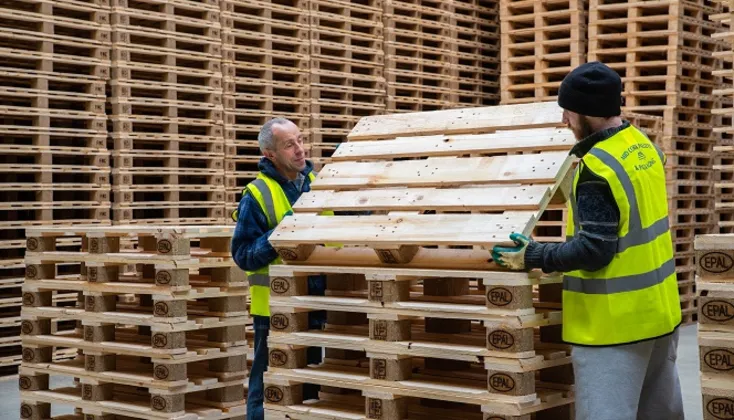
A study on wooden pallets was recently presented at Ecomondo, one of the leading international events dedicated to sustainability and the circular economy, highlighting their environmental impact and the potential of this product in the circular economy model. The study’s authors include Giacomo Goli, a lecturer at the University of Florence. The work focuses on the sustainable use of wood as a raw material.
The production of one standard wooden pallet measuring 1.2 x 0.8 x 0.09 m emits approximately 3.25 kg of CO₂ equivalent. For comparison, the production of a hamburger emits around 2 kg of CO₂, and a regular shower emits 0.5 kg. However, the study goes beyond the initial environmental impact.
One of the key findings shows that wooden pallets can store more carbon than is emitted during their production. A standard pallet weighing around 11.3 kg can store up to 22 kg of CO₂ equivalent. This makes wood a kind of “reservoir” for carbon, which is a significant environmental advantage and contributes to reducing global greenhouse gas emissions.
The balance between CO₂ emissions and absorbed carbon is negative, which creates a positive picture for wood as a raw material in the context of environmental sustainability. This allows us to state that the use of wooden pallets is environmentally beneficial and can play a key role in the implementation of a circular economy, promoting more responsible industrial practices.
During his presentation, Giacomo Goli highlighted that wood, thanks to its natural characteristics, is an efficient and sustainable material for many industrial sectors. The professor stressed the importance of further investment in research and development of wood-based solutions, not only in Italy, but also at a global level, in order to maximize environmental benefits and promote a more responsible management of natural resources.
In a global context where sustainable development is becoming an urgent need, the results of this study open up prospects for the future of the transport and logistics sectors, where pallets are a key element. The widespread adoption of wooden pallets could, in the long term, significantly contribute to reducing the global carbon footprint and establishing an economy that is more circular and sustainable.