
yesterday at 12:29
,Germany
Forests are among the most important allies worldwide in the fight against the climate crisis. However, it’s not just the tropical rainforest, often the focus of international summits, that plays a central role. Local forests also make a significant contribution: in Germany alone, they remove over 600,000 tons of CO₂ from the atmosphere daily and store the carbon in wood for the long term. This natural process makes wood one of the most climate-friendly building materials available.
During their growth, trees absorb large amounts of carbon dioxide, break down its components, and bind the carbon into their structure. One cubic meter of spruce wood contains around 250 kilograms of pure carbon – equivalent to about one ton of CO₂ removed from the atmosphere. Even when factoring in the energy required for harvesting, drying, processing, and transportation, an impressive CO₂ reduction potential of around 700 kilograms per cubic meter of wood remains. Short transport routes and the use of renewable energy in production further improve the climate balance.
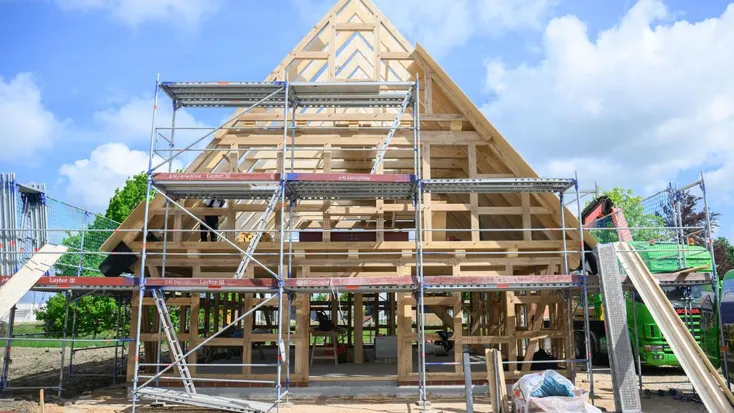
In construction, wood demonstrates its sustainable potential particularly impressively. When used in buildings, the carbon stored in the wood remains locked away for decades. A modern single-family home built with timber can sequester between 40 and 80 tons of CO₂ – as much as several combustion-engine cars emit in a year. As long as the building stands, this CO₂ is kept out of the atmosphere. A timber house thus becomes a kind of „climate account,“ where the stored carbon is deposited across generations.
This effect is amplified through sustainable forest management. For every tree harvested, a new one grows, binding fresh CO₂. The forest acts as a pump, continuously drawing greenhouse gases from the atmosphere, while the timber house serves as a storage unit. This creates a closed carbon cycle that also saves emissions by replacing particularly CO₂-intensive building materials like concrete or steel with wood.
Beyond its climate benefits, wood offers additional practical advantages. It is significantly lighter than concrete or steel, which reduces transport costs and the overall weight of structures. Timber components can also be precisely prefabricated in workshops. This considerably shortens construction time, improves quality, and reduces noise, dirt, and traffic congestion at construction sites.
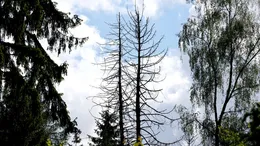
However, the question remains whether Germany has enough wood to promote timber construction on a large scale. Experts offer reassurance: Germany possesses some of the largest wood reserves in Europe. At the same time, forests face significant challenges. Spruce stands, in particular, are severely weakened by drought, heat, and pest infestations. Many trees must be removed to make way for more resilient species. Allowing this wood to rot unused or using it solely for energy purposes would be a missed opportunity. It would be more sensible to use the available quantities directly in construction.
Thus, timber construction in Germany could not only make an important contribution to climate protection but also become a key driver of resilient, future-oriented forestry.