

yesterday at 12:29
,Germany

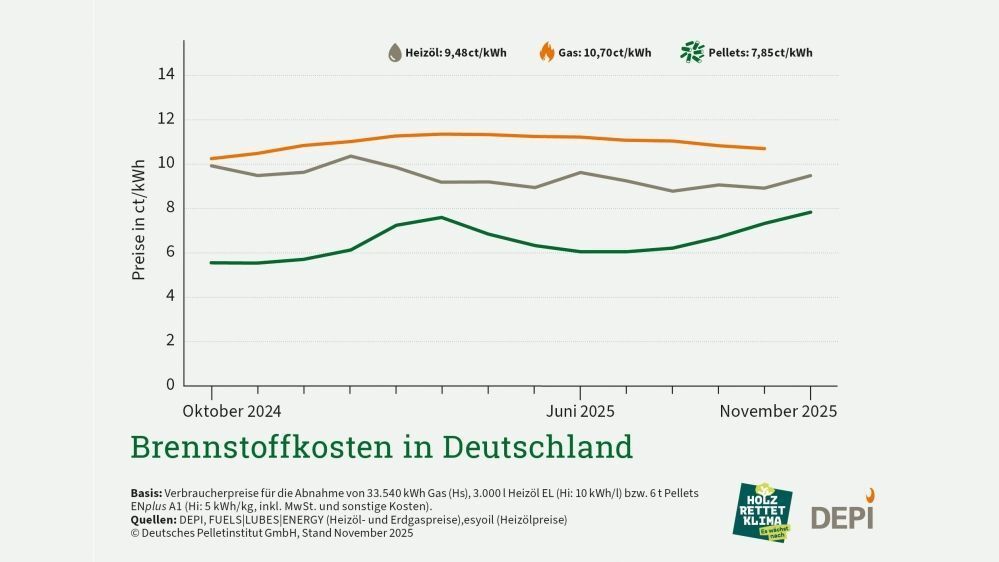
Wood pellet prices are noticeably increasing in November 2025 with the start of the heating season. Such a price rise in autumn is considered seasonally typical, though it is somewhat more pronounced this year. Reasons for this include rising costs in production and logistics. The German Pellet Price Index (DEPI) also shows significant regional differences in some cases.
Traditionally, the start of the heating period leads to increased demand in the market. Households that have not already replenished their pellet stocks in spring or summer often need to buy more during the colder months – and usually pay higher prices for it. This demand effect is one of the recurring drivers of rising pellet prices in autumn.
For a purchase quantity of six tons, prices according to DEPI in Central Germany are 386.77 euros per ton. In Southern Germany, the cost is 395.15 euros per ton, while consumers in Northern and Eastern Germany must expect an average of 397.17 euros per ton.
For larger delivery quantities of 26 tons, the price per ton drops significantly: In Central Germany, it is reported at 367.78 euros per ton, in Southern Germany at 377.41 euros, and in Northern and Eastern Germany at 382.04 euros per ton. All quoted prices include value-added tax.
The fact that the price increase in 2025 is more significant than in some previous years is primarily attributed to higher costs along the entire value chain – particularly in pellet production and transportation. For context, the DEPI, which has been published monthly since 2011, reflects the average end-consumer price for a ton of wood pellets of the ENplus A1 quality class in Germany. The calculation is based on defined framework conditions, including delivery within a 50-kilometer radius, encompassing all incidental costs and value-added tax. For net delivery contracts, the industry association refers to a separate DEPV pellet price.
Despite the current upward trend, the long-term price development of wood pellets is still considered significantly more stable than that of fossil fuels. Pellets are also regarded as a reliable, widely available, and comparatively cost-effective domestic fuel. Consumers who replenish their stocks early can usually benefit from more favorable conditions. The monthly updated index allows for continuous monitoring of price developments throughout the entire heating season.